A SERPENT IN THE GARDEN
©1994
Tor Pinney - All Rights Reserved
Crime and the Caribbean Cruiser
For
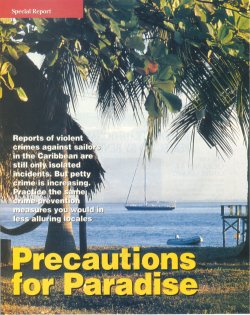
centuries, the Caribbean has lured sailors with its
perfect weather, steady trade winds and beautiful
islands. Yet from the beginning, there has been a
serpent in the garden. It was the pirates of old that
first violated the natural serenity of this mariner's
paradise. Today, the roving bands of buccaneers are
long gone, but there remain a few traces of the old
perils. A less glamorous breed of thieves and, in rare
instances, cutthroats still ply the waters and harbors
of tropical paradise.
 |
With
the vast increase in the number of cruising yachts and
charter boats, sailors are now visiting these once
remote islands in record numbers. Understandably so,
because most of the Caribbean is a safe cruising
ground most of the time. But boaters there shouldn't
let the beauty of the surroundings and the relaxed
pace lure them into a naive sense of complete
security. Just as in the rest of the modern world,
crime does exist there and crimes against yachtsmen,
although occasional and sporadic, do occur. Being the
victim of a criminal act, be it theft or personal
attack, can ruin a cruise.
Good
seamanship requires that mariners be aware, alert, and prepared
for any eventuality. This applies no less to threats of a human
nature. So let's consider what kinds of crime Caribbean sailors
might encounter, what's being done about them, how you can
protect yourself and what to do if it happens to you.
|
What's
happening?
The
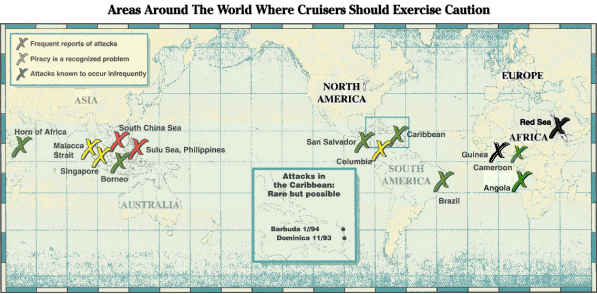
cruising world was shaken recently by news of a multiple murder
aboard a sailboat in Barbuda, near Antigua in the Leeward
Islands. On January 27, 1994, an American couple and two English
crewmen were found shot to death aboard the 65-foot racing
ketch, "Computacenter Challenger". Local authorities
tried their best to keep the incident out of the international
headlines, while at the same time calling upon Scotland Yard
detectives to assist in the investigation. Within a few weeks,
three young Barbudian men were charged with the killings.
The
previous November in Prince Rupert Bay, Dominica, an experienced
Caribbean single-hander woke one night to find two natives
entering his boat's cabin armed with a machete and a knife. In
the ensuing scuffle, the skipper was wounded. The intruders then
demanded to be sailed to St. Maarten where, 3 days later, the
sailor was left adrift off the coast, weak from his injuries and
manning a disabled vessel. The hijackers had openly discussed
plans to steal another crewed yacht to get them to St. Thomas.
Yet although he notified the police in St. Maarten, St. Kits and
Dominica, as far as he knows no investigation was conducted, nor
any arrests made.
While such
violent attacks are extremely rare in the West Indies, these
events serve to remind us that crime - even assault and murder -
is not just some faraway urban problem. An unwary yacht can
become a target.
Piracy is
defined as robbery or illegal violence at sea. But in fact, the
vast majority of crimes committed against Caribbean yachtsmen
occur in port, and - the above tragedies notwithstanding - fall
into the category of larceny, mostly petty; sometimes grand.
Probably
the most common crime against yachtsmen is the theft of dinghies
and outboard motors. A few years ago I spent several months in
Puerto La Cruz, Venezuela where sailors shared a morning radio
net on the VHF. Reports of dinghies being stolen were so common
- sometimes two or three in one night - that they became a
normal part of our daily life! Rumor had it that there was an
organized ring of thieves operating who were carting the
dinghies and outboard motors down to the Amazon region and
selling them to gold prospectors there. The police dutifully
recorded the complaints, but I never heard of any stolen tenders
being recovered. Dinghy theft happens relatively often, and in
almost every corner of the Caribbean.
Another
problem sailors face is the theft of items off the deck of their
yachts while they're ashore or asleep. Natives, some of them
children, paddle small skiffs or simply swim through the harbor
and swipe anything easily reached and removed. A rash of
paddle-by petty thefts like this recently put sailors on their
guard in Grenada's downtown yacht harbor, but they can occur
almost anywhere.
Much more
devastating to the cruising sailor is to come home after an
evening ashore to find the companionway broken open, the cabin
ransacked, and their valuables stolen. A cruising couple in St.
Thomas reported three such break-ins in one evening in the
island's crowded downtown anchorage. Apparently, the thieves
watched as sailors dinghied ashore, then stole the same tenders
to go out to the anchored vessels. The dinghies were later found
adrift in the harbor, but the stolen cameras, jewelry, radios,
and cash were never recovered.
It is not
only aboard their boats that sailors can encounter trouble. A
cruising couple ashore in San Juan, Puerto Rico was startled
when a youth ran past them, snatching the woman's gold necklace
as he rushed by. The kid vanished in a wink and the jewelry with
him.
Perhaps a
sailor's greatest nightmare is having his entire boat stolen.
The target is most often a vessel that has been left unattended
in port for awhile. As any insurance investigator can tell you,
yachts are stolen all over the world. That it also happens in
the Caribbean is attested to by the presence of "Reward For
Information" notices posted on marina bulletin boards
throughout the islands.
Why
me?
Why do
these crooks single out yachts as their targets? In a developing
country, a yacht can't help but stand out. To a native who
subsists on a thousand dollars a year, a yacht represents
unimaginable, unattainable wealth. Little wonder that a thief
would be drawn to such an object.
While
poverty is a common impetus for theft, greed sometimes spawns
more aggressive crimes. There was a general scare among sailors
some years ago that smugglers were attacking yachts and then
stealing them to transport drugs. Much of this occurred in the
Bahamas and near Columbia. In a couple of headline cases, a
vessel's crew was killed. This brand of hard-core piracy on the
high seas seems to have declined in the face of the U.S. Coast
Guard's blockade against water-born drug smuggling in the
Caribbean. In fact, the U.S. Coast Guard Public Affairs office
claims no reports of piracy in territorial waters in the past 10
years. However, it is commonly agreed that if a yacht
accidentally stumbles upon a drug-running transaction in some
remote place, the crew could well be in serious danger.
Smugglers will sometimes resort to extreme measures to prevent
witnesses from reporting them.
More
alarming today is the spread of crack cocaine into the West
Indies, particularly the Lesser Antilles. Just as it has done in
cities around the world, this highly addictive drug has brought
with it a huge increase in local robberies. Island authorities
are working overtime to stem the flow of this drug and the
higher crime rate with varying success. But the problem
persists, and some of the stealing is inevitably directed
towards the yachts in the harbor and the yachtsmen ashore.
There's
another factor contributing to crime in paradise, recognized by
everyone but for some reason rarely spoken, and almost never
written. On some black West Indian islands, local resentment of
tourists takes on racial overtones, and it motivates acts
offensive, larcenous and, occasionally, violent. The trend seems
to be directly proportional to the amount of tourist traffic
with which an island is bombarded. Little wonder, then, that
some locals' attitudes in the U.S. Virgin Islands can be a bit
of a shock to the first-time visitor.
Like crack
cocaine, so-called "reverse racism" probably filtered
down islands from the United States. Unlike crack, racism is not
strictly illegal and will be much harder to eliminate. The
crimes it engenders are more likely to be confrontational and
for that reason more dangerous than crimes of need or greed.
Keep in
mind that not every theft is committed by natives. The yachting
community has a few bad seeds, too. Once in awhile you'll hear
of some scroungy cruising boat being caught with someone else's
dinghy or a half-dozen stolen outboard motors aboard. However,
they tend to find that getting into trouble with the law down
there is a fast, long-lasting cure for the common criminal.
What's
being done about it?
One
Thursday last February, an American doctor and his wife were
robbed at gunpoint on an Antiguan beach. They immediately
reported it to the police; the thieves were caught within 45
minutes! That Saturday, the suspects were identified in a police
line-up, and on Monday they were tried, convicted, and held
without bail for sentencing. They could get 20 years. (Oh, if
only our own judicial system were so swift and decisive!)
Incidentally, the Antiguan authorities wanted it made clear that
these thieves were not Antiguans, but had come over from the
impoverished island of Dominica, apparently with the intention
of robbing someone.
All
Caribbean ports of call welcome, and many rely upon, the revenue
that tourism generates. A crime against a tourist is a direct
strike against the locals' income. If an island or region gets a
reputation for having a high crime rate, the tourists will stop
coming, and for many of these tiny nations that can spell
economic disaster. Therefore, the authorities there are very
highly motivated to prevent crime against, and prosecute
criminals who attack tourists. The police will often act very
quickly to catch these crooks and return stolen property.
By the
same token, authorities are not always inclined to talk about
the problem. In researching this article, I queried the
Ministers of Tourism and the Police Commissioners of St. Thomas,
Antigua, St. Lucia and Grenada, by mail and by fax. None of them
responded to my requests for information on specific measures
being taken to protect yachtsmen in their islands. Whether they
preferred to keep a low profile for public relations reasons, or
just didn't think the issue was worthy of comment, I can't say.
While the police and politicians certainly have ample reason to
keep crime at bay, most sailors I've spoken to who have been
victims of crime in the Caribbean agree that, in many cases,
when you're on a boat, you're on your own.
What
can cruisers do about it?
What can
the average cruising sailor or charterer do to minimize the risk
of becoming a victim of crime in the Caribbean? When we visit
foreign ports, we are guests in their country. As such, it is
our responsibility to be sensitive to our hosts' customs and
temperaments. In developing countries, this includes maintaining
an awareness of our apparent wealth and how our presence effects
the local people. Leading a poor fisherman or a hungry youngster
into temptation by leaving valuable property lying around is
unfair to them, and it's asking for trouble.
In marinas
as well as at anchor, make it a habit to lock up your boat
whenever you leave it. Hatches should be dogged down from the
inside and the companionway secured with a stout padlock. An
internal lock is even better because it can't be severed by hack
saw or bolt cutters. If you're going ashore in the evening,
leave a cabin light on, and perhaps the radio playing, to make
it look and sound as if someone's home. Clear the decks of all
easily removable gear, such as binoculars, cameras, dive gear,
etc. and, if an outboard motor is stored on a rail bracket,
chain and lock it.
Thieves
often come in the night. Most sailors sleep with open hatches in
the balmy tropics, but this can serve as an invitation to
robbers to search for booty belowdecks, which may lead to a
physical confrontation. The unfortunate skipper who was hijacked
in Dominica now feels strongly that nocturnal boarders must be
barred from entering the cabin. He has made a stainless steel
grate that blocks the companionway while he sleeps, and inside
metal straps at the overhead hatches that prevent them opening
more than 6-inches or so. This system allows ample ventilation
on warm nights while letting the crew sleep more securely.
After
having his boat ransacked once, one skipper I know replaced his
boat's teak companionway trim boards with 1/4" stainless
steel flat bar, cut to shape and through bolted with carriage
bolts. This made it nearly impossible to break in, even with a
crow bar. The companionway lock was recessed, and there was a
barrel-bolt inside to secure the companionway while the crew
slept. The clincher was a pair of mace canisters fastened at the
companionway, triggered by trip cords if the hatch is opened
incorrectly while the boat's unattended. One can empties into
the face of the intruder; the other is directed into the salon,
rendering the cabin uninhabitable for awhile. A bit excessive,
you say? That captain's answer is, "You won't think so once
you've been robbed!"
On a
cruising boat, consider installing an alarm system. This can be
done inexpensively by wiring a siren and bright deck and cockpit
lights to disconnect switches at all hatches. A pressure
sensitive floor mat in the cockpit, wired to an alarm signal, is
an excellent warning device.
There's
another kind of alarm system that's easier to install - and wags
when you return to the boat! A few years ago, I cruised
throughout the South and Central American Caribbean with a
90-lb. yellow Labrador Retriever aboard. "Shaolin" was
gentle as a lamb but, by virtue of his size, intimidating to
behold. He was also trained to bark on command. So whenever we'd
enter a small harbor, invariably attracting the attention of the
local villagers, I'd take the dog onto the foredeck, sit him
down, and order him to bark. Just twice. His deep-throated
"Woof!" would echo across the water, informing
everyone within earshot that this boat was his territory.
Needless to say, no one ever tried to board SPARROW uninvited!
For sailors with canine crew aboard, remember that even a small
dog will discourage unwanted visitors. Let him be seen and, once
in a while, heard. Of course, at night man's best friend is a
sailor's best early warning system against intruders.
While in
port, lock up the life raft. When away from the boat for any
length of time, disable (disconnect) the main engine's starter.
In general, look at your boat from the point of view of the
thief; then do everything you can to make it hard for him.
Below
decks, hide valuables, especially jewelry, cameras and cash.
Most third world thieves are looking for recognizable items that
are easy to take and easy to sell. Don't keep your entire
cruising kitty aboard in cash. Use a Visa card to draw funds
from a bank. If you must carry more than the week's money
aboard, buy traveler's checks. Some sailors choose to leave a
little cash, $20 or so, out where it can be easily found so that
a thief might grab it and leave feeling satisfied without doing
further damage.
In harbors
with a reputation for theft, try to raft up with another boat
and stagger your shore leaves to ensure that someone is aboard
at least one of the boats at all times.
Always
secure the dinghy to the dock or a tree trunk with chain and
lock. Overnight, chain it to the mothership or, better still,
hoist it out of the water on davits or with a halyard. Lock the
outboard to the tender, and lock oars to the dink's seat. Don't
leave anything of value (like a flashlight or sunglasses) lying
around on seats or floorboards. Remember, heavy chain is harder
to cut than cable; a hefty padlock won't yield to a hammer-blow
as easily as a small one.
When tied
up at a dinghy dock, a tender bearing the mothership's name is
an advertisement that your vessel is probably unattended. Better
to identify your dink with her own name, complimentary to, but
different from, the ship. Indicating your radio call sign may
help someone return the skiff if it's ever lost and found.
Avoid
wearing jewelry while ashore in third world countries. It
attracts snatch-&-run thieves and muggers, particularly in
Latin American cities. Ask the local police where and when it is
or isn't safe to roam, and beware of being led to a remote place
by a seemingly helpful local.
Since the
troublemakers are just a handful of individuals, the trouble
spots sometimes change. A port that was perfectly safe last
season may not be so today, and vice versa. To keep abreast of
which ports are currently troublesome, ask other cruising
sailors you meet along your route. Charterers and cruisers alike
will find local charter company managers very up-to-date on the
subject. Check SSCA (Seven Seas Cruising Association) bulletins
for cruising members' reports, and tune in VHF, SSB and Ham
radio nets for the latest scuttlebutt. Remember, forewarned is
forearmed.
Speaking
of forearmed, keeping firearms aboard for protection may not be
permitted in some countries you visit. In these countries,
government authorities will remove ship's weapons to be locked
up ashore and returned when you clear out. Whether or not a gun
is a good thing to have aboard is a personal decision; there are
pros and cons and sailors with differing opinions will argue the
point and never agree. But if you choose to arm your vessel,
keep weapons in a discreet, locked locker (at least during the
day) and instruct crewmembers in their safe operation. Always
declare firearms when clearing into a new country. The
consequences of being caught for not doing this can be severe.
What
should you do if you're a victim?
If you are
ever the victim of a crime while cruising, notify the local
authorities immediately. Request a copy of the police report for
your insurance company, whom you should also notify as soon as
possible if your policy covers the damages incurred. If you're
bare-boating, contact the charter company office. Log the event
in the ship's log; this may be a useful legal document later. If
the situation warrants it, warn your neighbors in the harbor or
marina so that they may protect themselves against a similar
mishap. Depending on the nature of the crime and the general
circumstances, it may be prudent to move your vessel to a safer
haven.
What's the bottom line?
The
Caribbean is truly one of the beautiful places, and
features some of the most pleasat cruising, in the world. Anyone
who has spent time there knows that most West Indians and Latin
Americans are friendly, honest folks. If this article seems to
paint a dismal picture, remember that it spotlights a handful of
bad guys. The vast majority of natives, like the vast majority
of people everywhere, are kind, friendly and generous. We'd be foolish to ignore the existence of
crime against cruisers in the Caribbean, but we'd be more
foolish still to think it's any worse or more dangerous than
most other places in this crazy world. A snake in the garden doesn't
ruin the garden. It only requires that you enter with open eyes
and watch where you step.
~
End ~
Back
to List of Tor's Tips
