Vancouver
to the Yukon
I passed
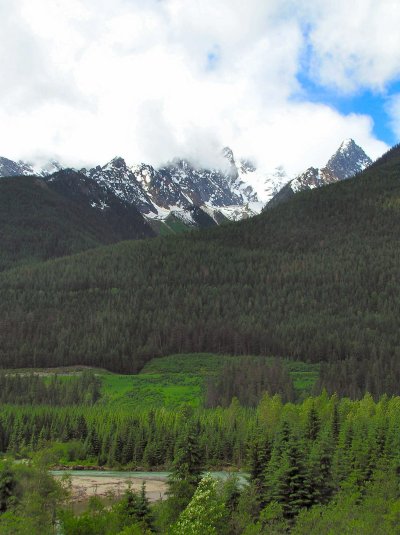
through some powerfully beautiful mountain country - the
Whistler/Blackcomb Mountains, I believe - northeast of
Vancouver, but I did not linger. I was tracking eastward towards
the fabled Banff region of the Canadian Rockies.
|
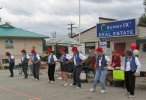
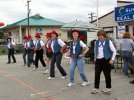
Soon
after coming down out of that first mountain range
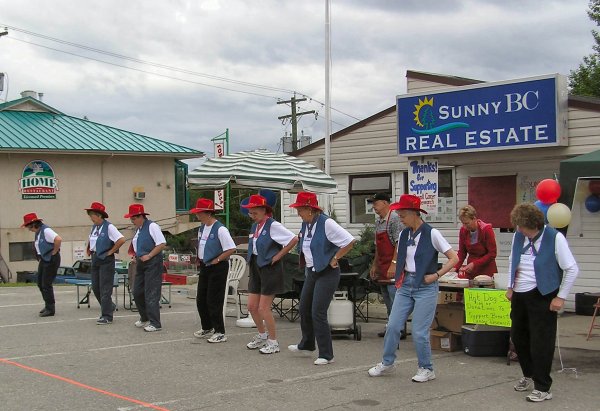
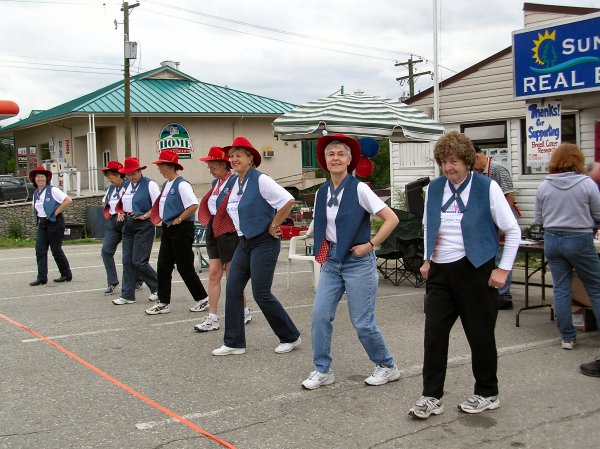
into lake country I happened upon a small-town
fundraiser in progress featuring these swingin' line
dancers. Who says we don't get wild & crazy out
here in the sticks?
|
|
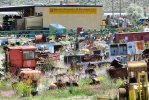 |
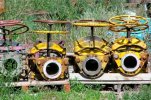
Somewhere
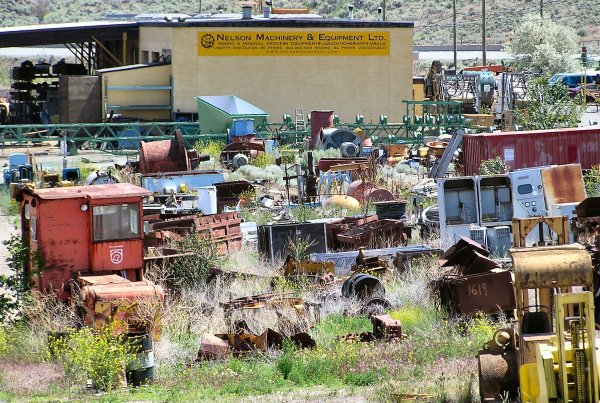
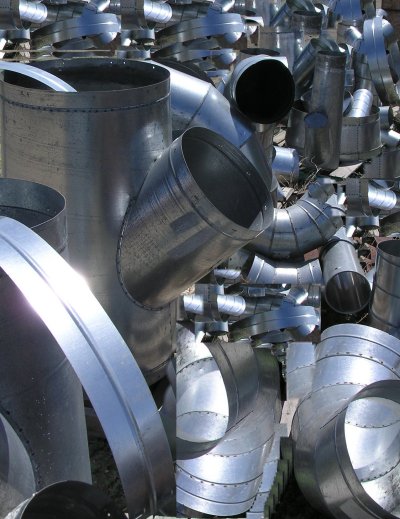
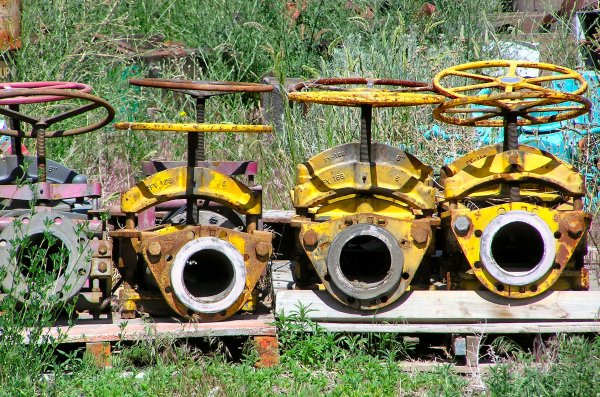
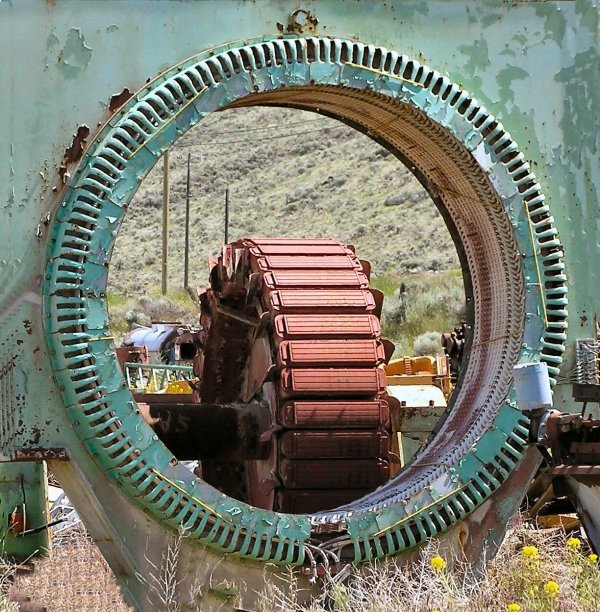
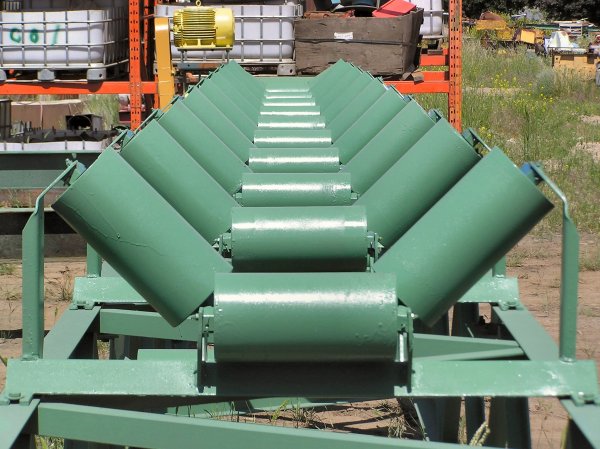
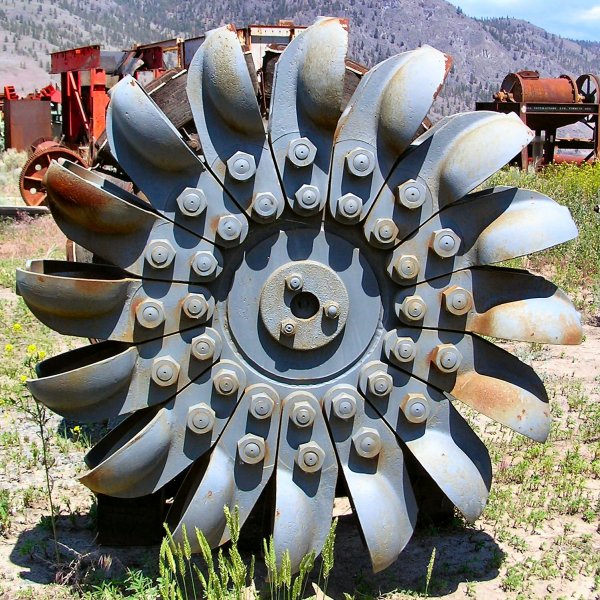
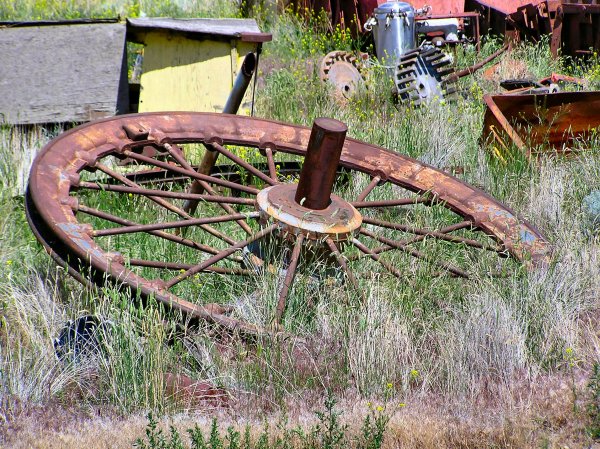
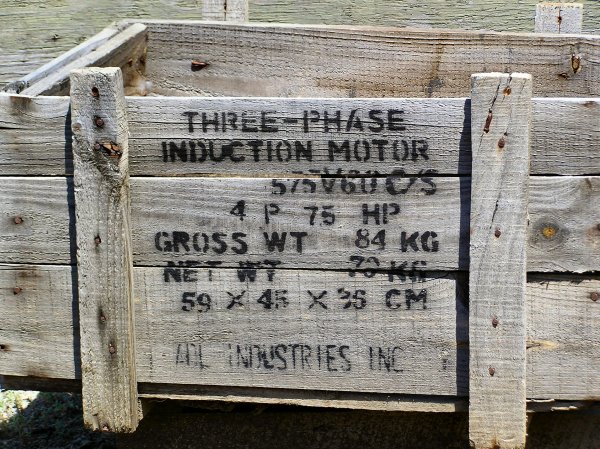
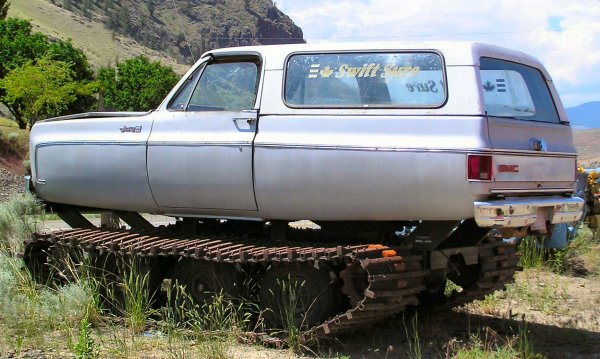
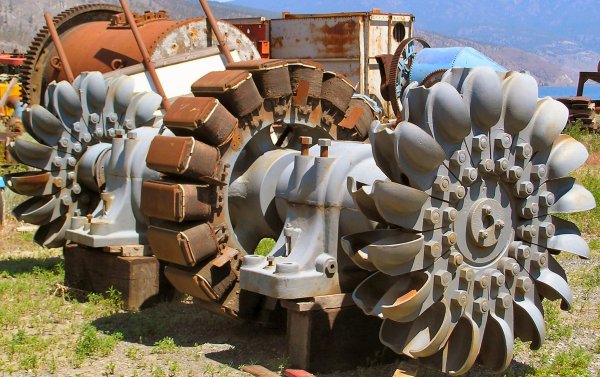
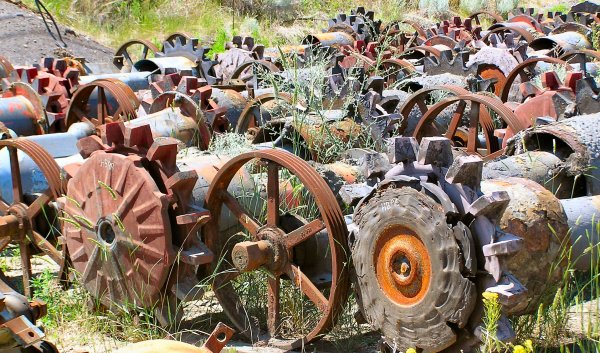
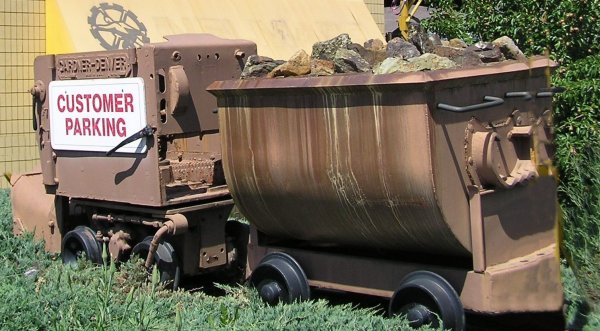
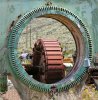
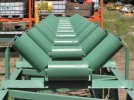
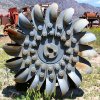
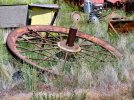
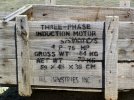
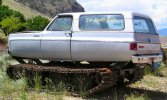
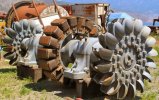
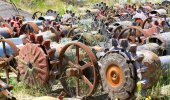
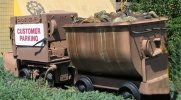
in south central British Columbia I drove by a mining
& mineral process equipment re-seller, which is
something I never new existed. Did you? The place was
such an unusual sight - acres of bizarre-looking
machinery and parts - that I stopped to check it out
and wound up taking quite a few photographs. The
company buys this stuff at liquidation sales,
refurbishes much of it, and sells it worldwide via the
Internet.
|

|
click
any thumbnail photo to enlarge
The
Road to Banff
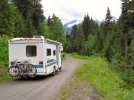 |
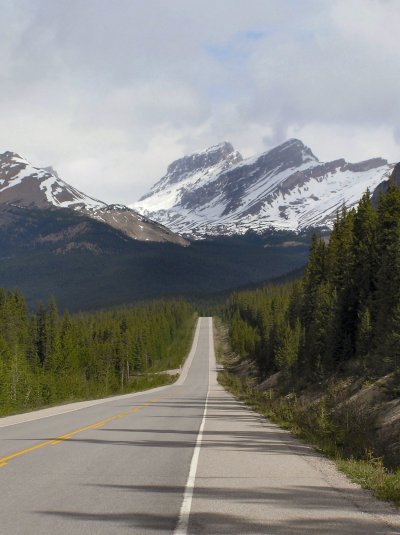
Rogers
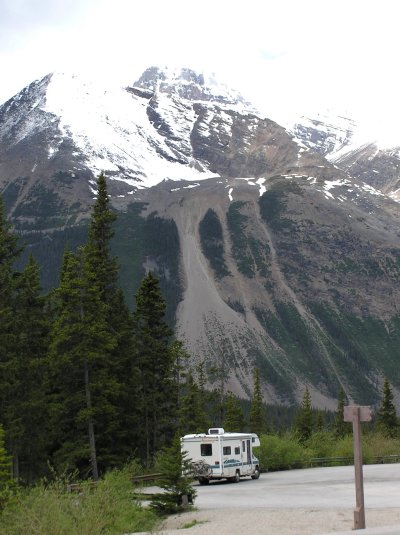
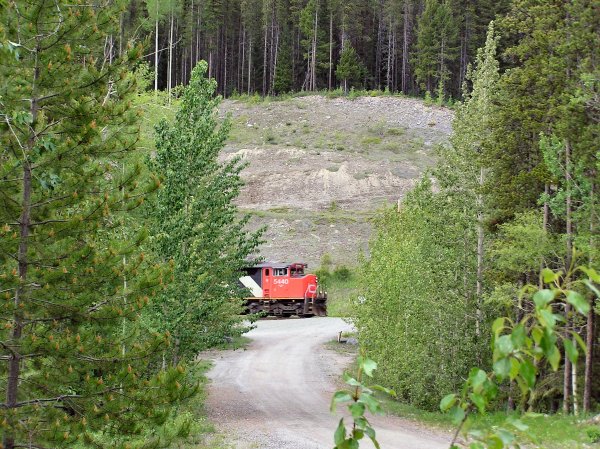
Pass through the mountains west of Banff was a pretty
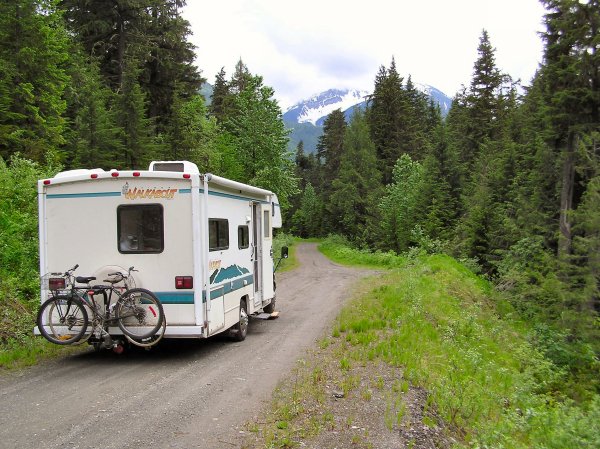
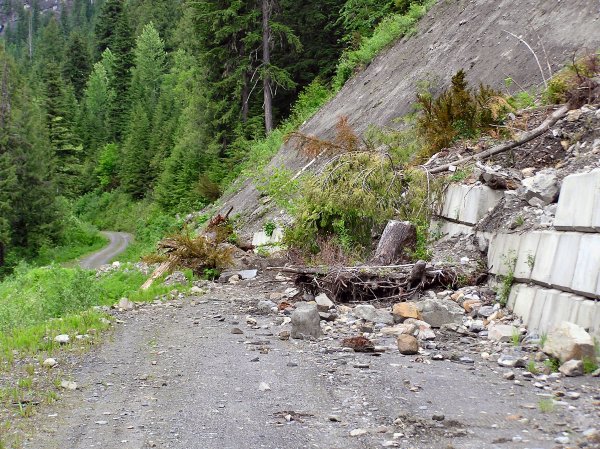
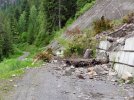
spectacular place. I found a forest road that was
blocked by a landslide a mile or so back from the
highway and I parked there for a couple of days,
alternately writing and trail-biking into the wild
country beyond the slide.
|
 |
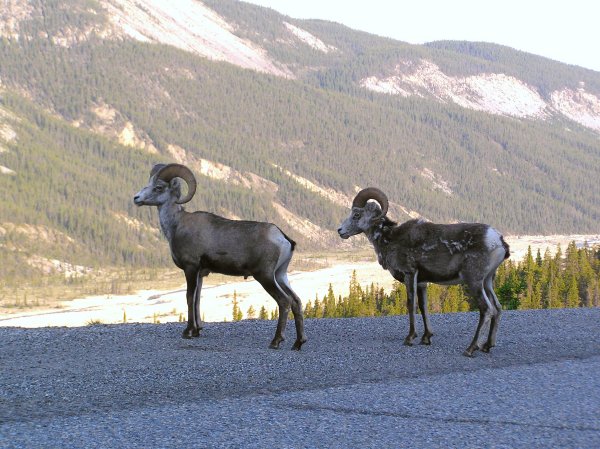
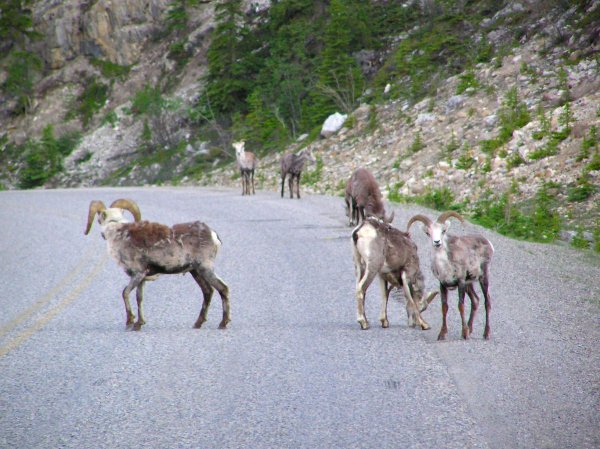
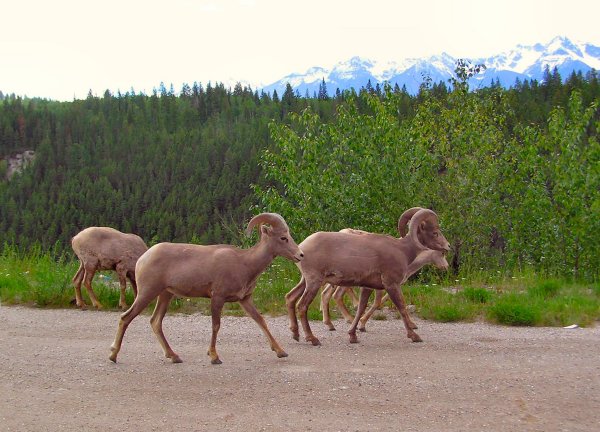
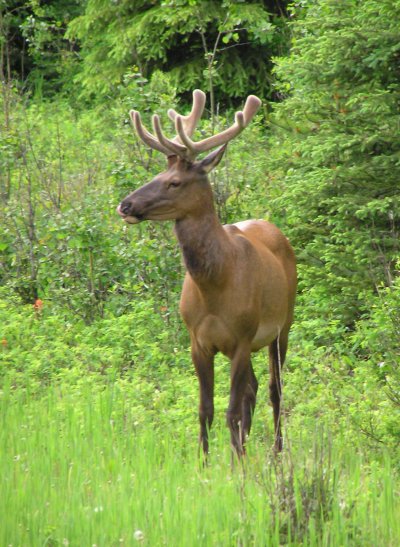
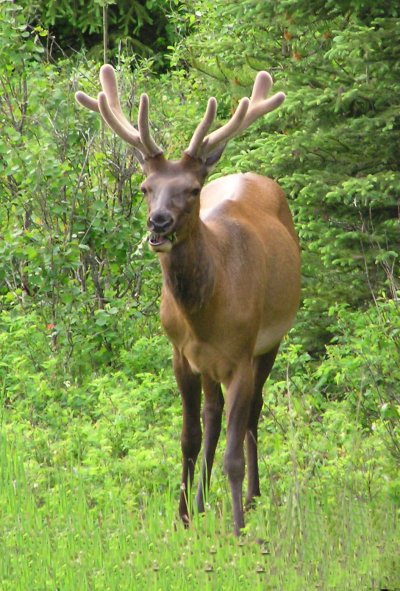
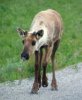
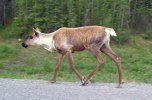
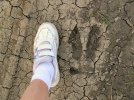
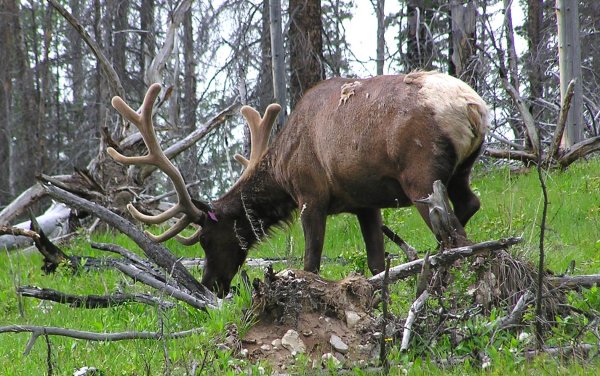
I began
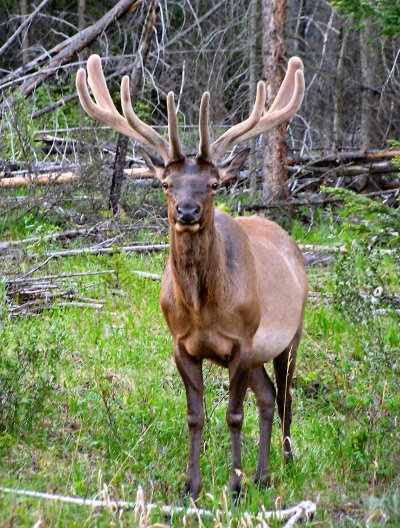
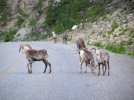
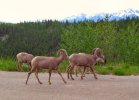
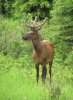
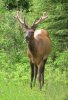
seeing more and more wildlife, mostly alongside the roads as I
traveled in the RV.

|
|
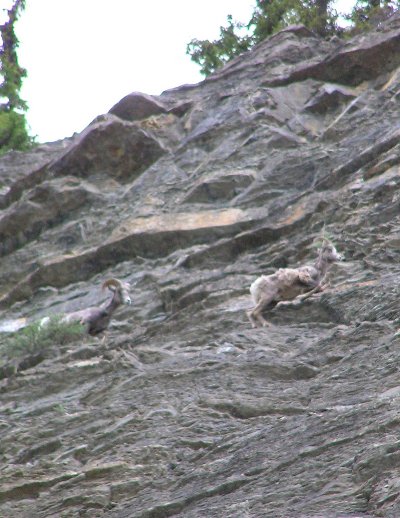
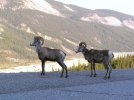
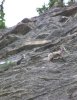
Sometimes
pulling over to observe the local wildlife can be
dangerous in the most unexpected ways. I stopped to
watch the mountain goats way up on the cliff in this
photo. When they moved behind a ledge out of view, I
got back in my RV and prepared to drive on, but before
I did I heard several loud BANGS on my roof. Realizing
those goats were kicking loose rocks down from the
high cliff above me, I pulled out as quickly as I
could.
|
|
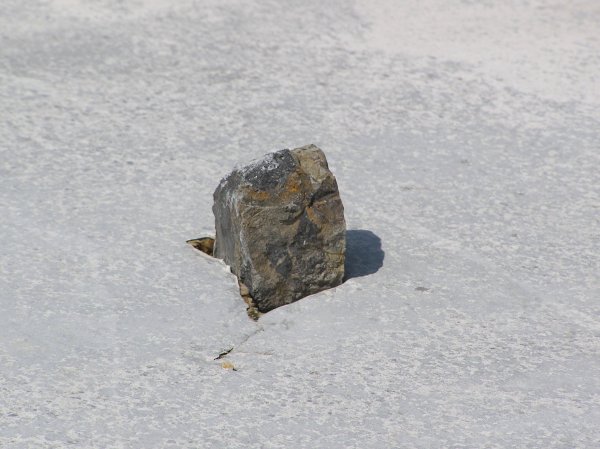
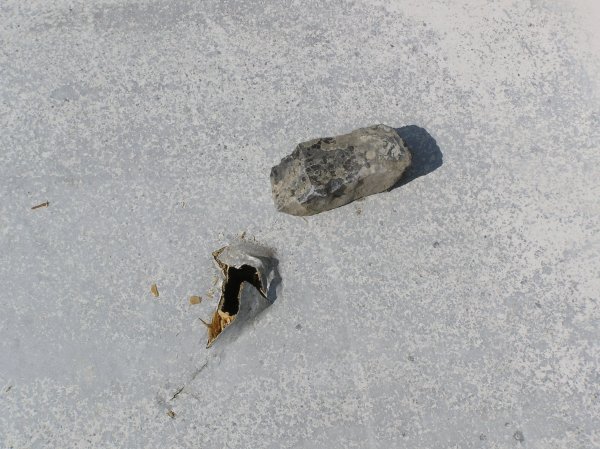
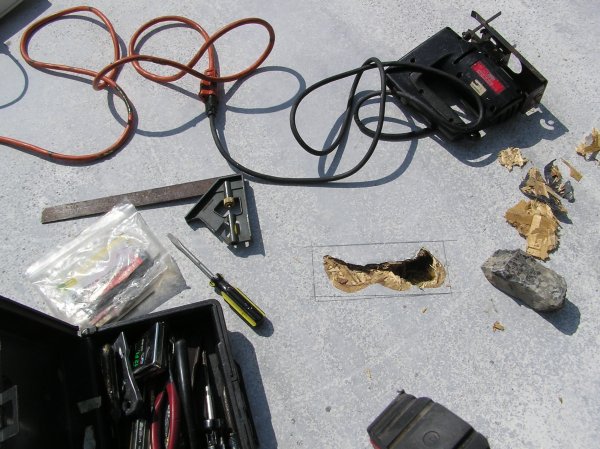
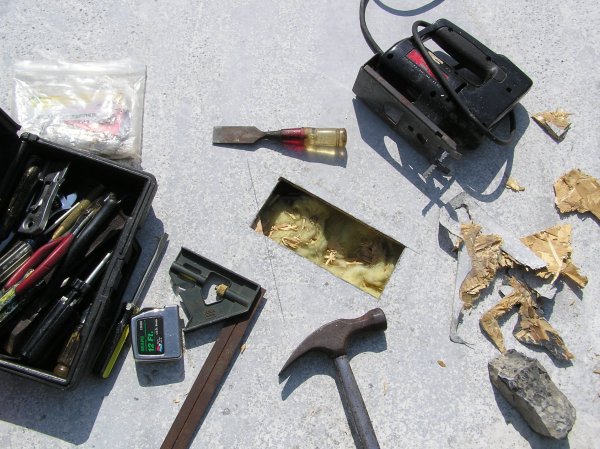
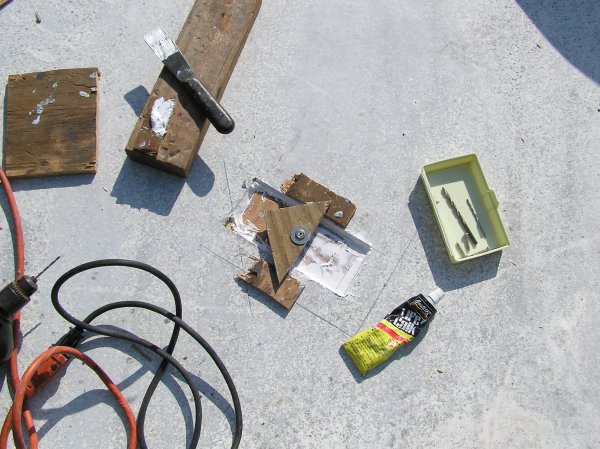
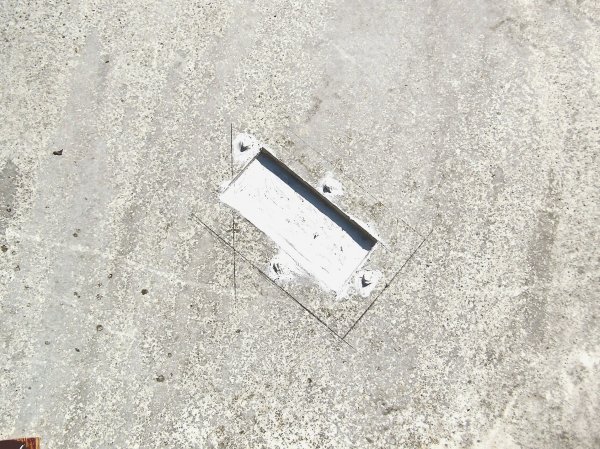
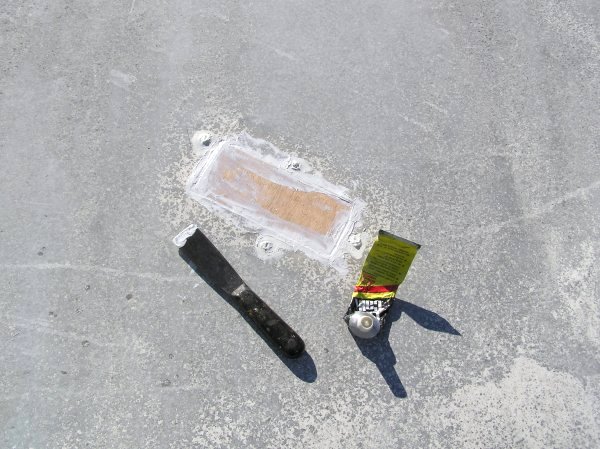
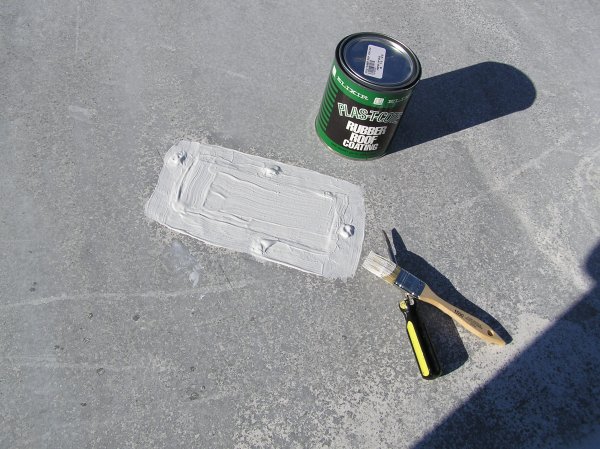
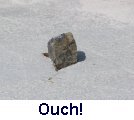
It wasn't until a couple of days later that I noticed
a jagged, 3" crack in the ceiling inside the
cabin. Right away I suspected what had happened, and
sure enough when I dug out the ladder and got up on
the roof to investigate I found a large, wedge-shaped
rock embedded so deeply that it had cracked the inside
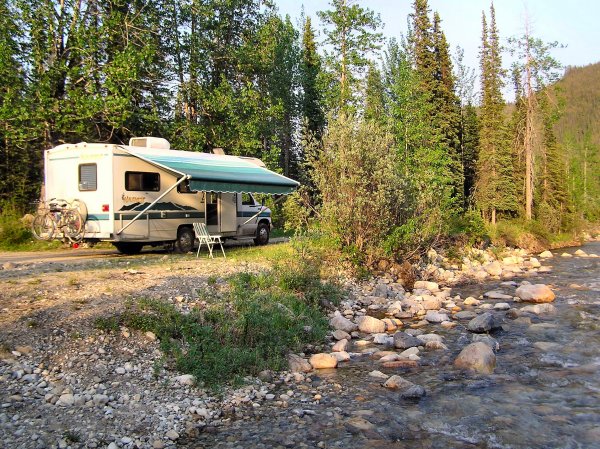
ceiling several inches beneath. I spend most of an
afternoon repairing the hole, parked in a tranquil
spot by a clear mountain stream.
|
|
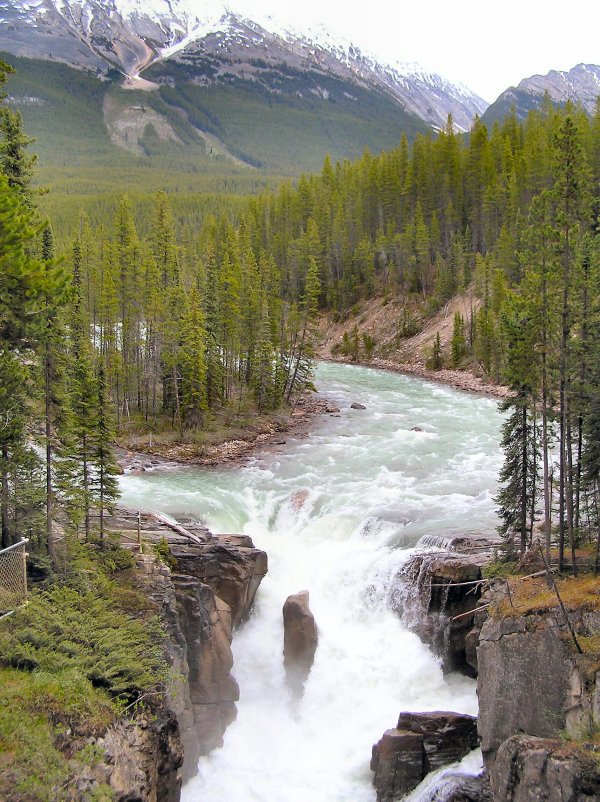
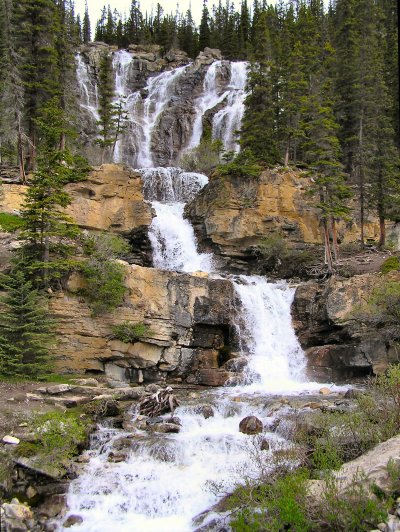
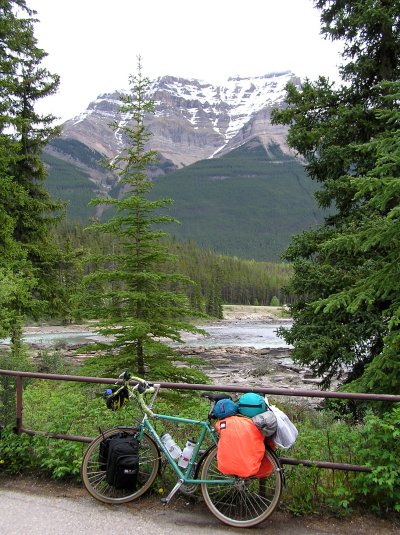
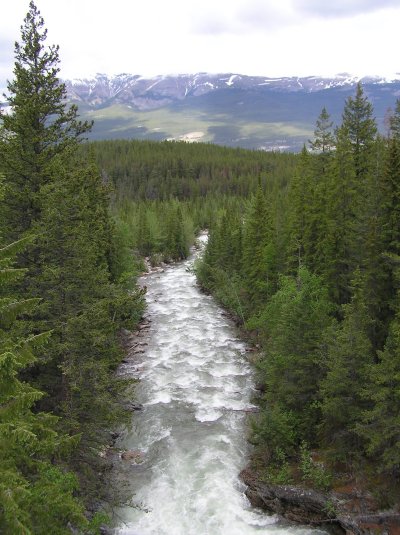
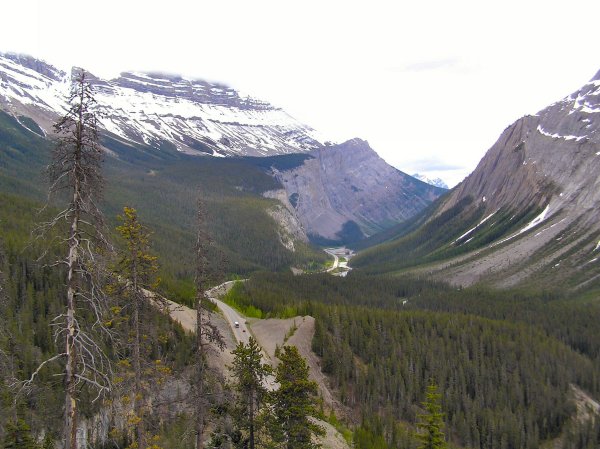
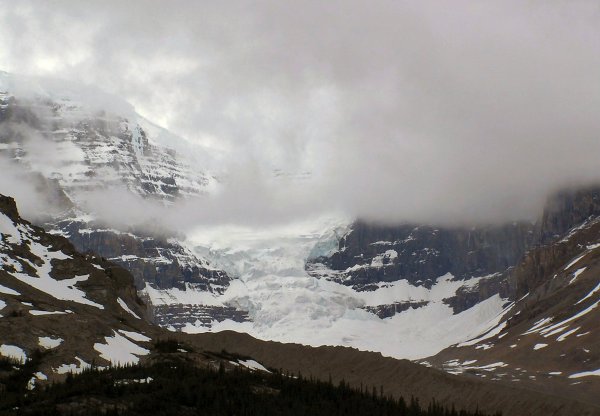
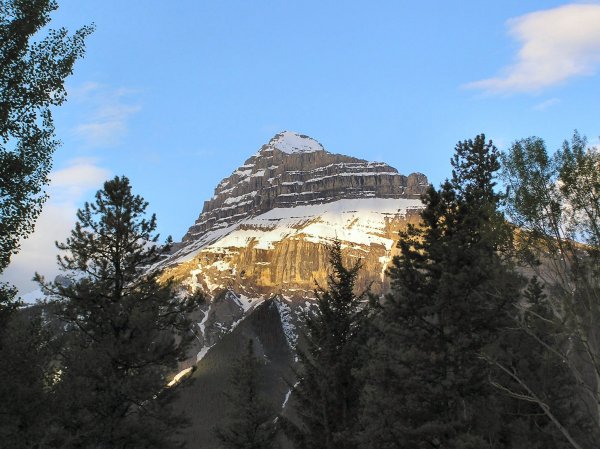
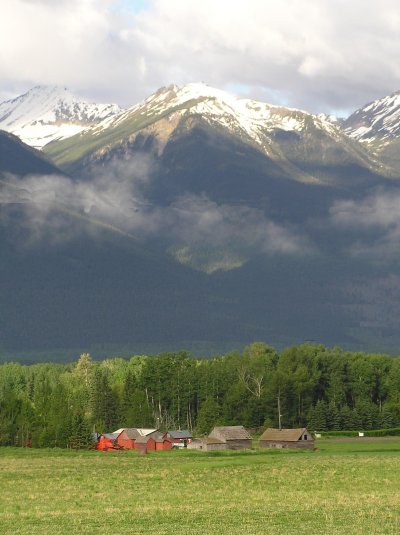
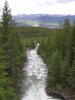
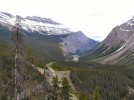
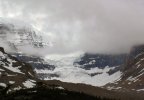
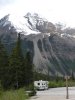
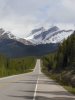
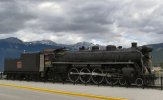
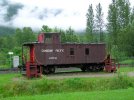
The Banff
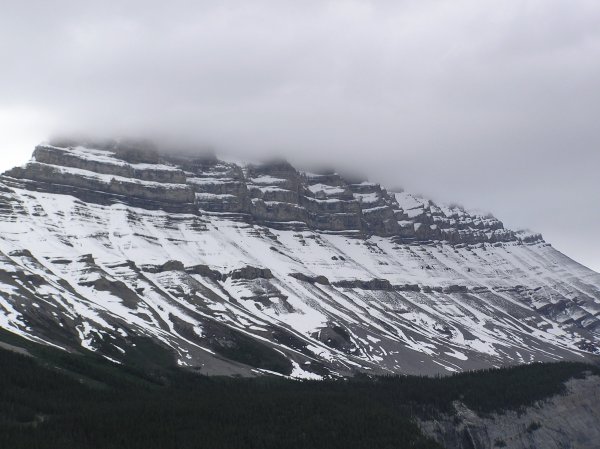
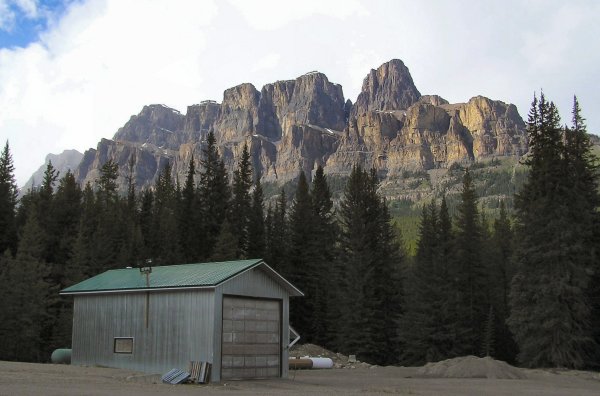
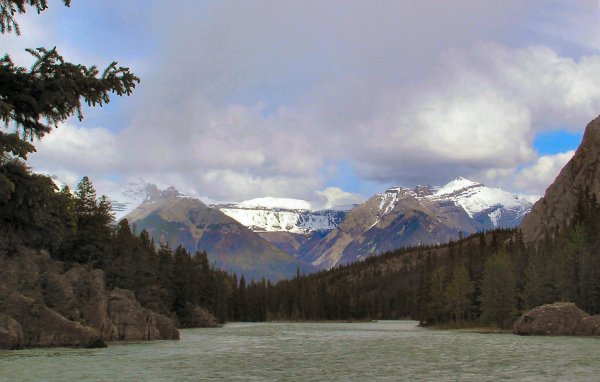
and Jasper National Parks were as advertised. Few places in
this world are as stunningly beautiful. I don't know enough
adjectives to describe it adequately. See for yourself:
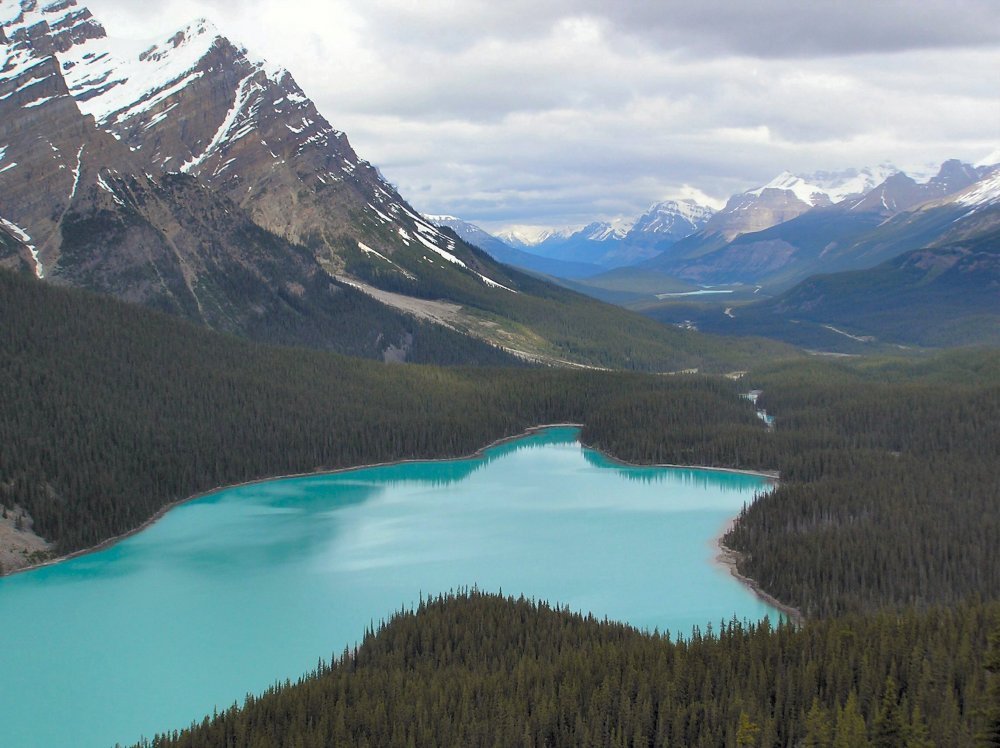
(Hey, do I take some awesome photos or what?)
From
Jasper I decided to head west again, to the city of Prince
George, BC to re-provision. I spent the night a little west of
Jasper and got an early start the next day, just before sunrise.
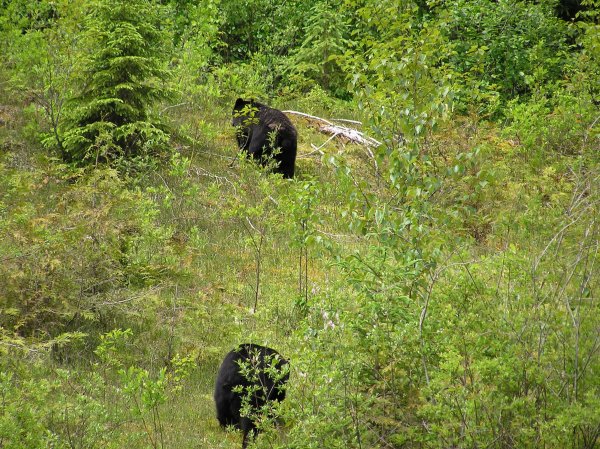
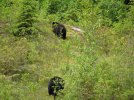
In the first 15 minutes, I saw several bears, two elk, a moose
and a bunch of deer. Before that morning was over I counted a
dozen more bears, mostly black and one brown, grazing alongside
the road, seemingly oblivious to the passing traffic.
Bear
Facts

If that
morning's drive was any indication, there are a LOT of bears in
these woods. Way more bears than people. I sometimes hike and
bike way back into the forest, so I've been making a point of
learning how to deal with these big fellows, talking to locals,
rangers and even a couple of bear hunters. Here are a few things
I've learned:
-
Make
noise when you're hiking in thick brush, or when approaching
a blind turn in the trail. This is especially important when
moving fast on a mountain bike. Most bears will move away if
they hear you coming. Hand-clapping works. So does calling
out in a strong base voice, or even singing, which is my
favorite technique. I find that if I sing calypso songs,
particularly old Harry Belafonte and Mighty Sparrow tunes, I
never see any bears on the trail. Barry Manilow songs are
said to put the bears into a modified state of hibernation.
However, singing any kind of rap music will almost certainly
cause all bears within earshot to attack immediately, even
black bears.
Seriously though, do not whistle or make other high-pitched
sounds. Small animals such as rabbits and squirrels often
make high screeching noises when they're being attacked by
predators. This is the sound of a death in progress, an
invitation for bears to investigate to see whether there's a
free meal waiting to be taken away from some smaller
predator.
-
If you
encounter a bear in the woods, stop and then back away
slowly. If the bear follows, stop and hold your ground. Talk
to the bear to help it identify you as a human. Avoid making
eye contact. Don't turn your back on the bear. Don't run -
you can't outrun a bear, not even on a bicycle.
-
A bear
may charge at you and then turn away at the last moment. I
don't know how you're supposed to know if he's going to turn
away, but apparently it does happen sometimes. At that
point, wave your arms, yell at the bear, make noise. If the
bear continues to follow you, throw rocks or sticks to drive
him away. Don't allow him to follow you.
-
If a
bear attacks you unprovoked, fight back as hard as you can
with anything you can get your hands on. I carry bear spray
and a club most of the time now when I'm out in the woods. I
bring along my 12-gauge sawed-off shotgun when local laws
don't prohibit it. With its shortened barrel, pistol grip
stock and shoulder strap (my modifications) it's easy to
carry slung across my back. I keep it loaded with alternate
rounds of buckshot and rifle slugs. It packs a punch at
close range and, while I doubt you would kill a bear
instantly with a 12-gauge, you might dissuade him from
killing you. Of course, if you manage to fire a rifle slug
into a bears heart, it will die. I'm not trying to be some
kind of Davie Crockett macho man about this stuff, but I do
intend to defend myself if I am ever attacked.
-
If you
literally stumble into a bear (or ride smack into one while
trail-biking, which has been known to happen) so that he has
reason to think he's being attacked, he will almost
certainly fight back. In that case, the local wisdom seems
to be to take a submissive approach by laying down on your
stomach and covering your head and neck as well as you can,
to show the bear you're no threat.
-
Some
people recommend carrying bear spray, which is a strong
pepper spray in an aerosol can. I bought some and wear it on
my belt whenever I go into the woods up here. Some claim it
has saved their lives when they were attacked. On the other
hand, one bear hunter scoffed at the idea and said the spray
will only piss a bear off more. Who knows? There seem to be
more votes for than against this form of protection, so I
carry it.
-
That
same hunter told me a story of being attacked by a bear in
his campsite one evening. His brother, who was with him,
grabbed a small log from the firewood pile and slammed it
down on the bear's skull as hard as he could. The log
snapped in two and the bear didn't even seem to notice. As
it charged at the brother, this guy telling me the story
said he picked up a fishing pole that happened to be handy
and slapped the bear on the snout with it. The bear
instantly broke off the attack and took off running. In
another story I heard just yesterday, a fellow being
attacked smacked the bear on the snout with a rock and the
bear stopped and went away. It seems bears, like dogs, have
sensitive snouts. So I carry a hefty stick when I'm hiking
if I don't have the shotgun with me.
|
Hell,
I don't know. If one of those huge monsters actually
attacks me I just might die of fright on the spot, but
I hope I'd fight. Yeah, I'd fight. I'd be too scared
not to. Mostly I hope I never get to find out. It
boils down to karma anyway, doesn't it? I mean, you
could get run over by a truck just crossing a street,
right? Lots more people get run over than mauled by
bears, don't they? Well, maybe not out in the woods.
|
 |
Everybody
up here has a bear story. I've heard some really scary ones from
the locals. It seems people are killed up here every year. The
papers and tourist brochures don't play it up, but according to
the people that live here it happens fairly often. Bears do
sometimes attack for no apparent reason. One bear killed an
entire family of three at Laird Hot Springs last summer, a place
I visited a few days ago. They're unpredictable and a very real
danger in these parts (the bears, not the families of three).
Still, in the end I don't think its reason enough to stay out of
the woods any more than sharks are reason enough to stay out of
the water, assuming you apply some common sense to different
situations. After that, you just pays your money and you takes
your chances.
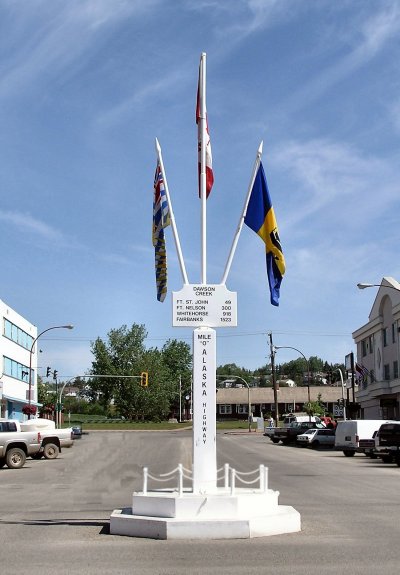
 I ran my errands in the City of Prince George, got out the same
day and headed north. In another day or two I reached Dawson
Creek and the official beginning of the famous, or should I say
infamous, Alaska Highway.
I ran my errands in the City of Prince George, got out the same
day and headed north. In another day or two I reached Dawson
Creek and the official beginning of the famous, or should I say
infamous, Alaska Highway.
The
Alaska Highway is sometimes described as a 1500-mile dirt
& gravel track through the wilderness, but that's by people
that haven't been on it in the past 20 years, if ever.
Certainly, that's how the road started out back in the early-mid
1940's when the American Army built it as a US/Canadian military
defense route, but today nothing could be further from the
truth. I have found the Alaska Highway to be a first-rate,
properly paved and very well maintained modern highway,
comfortably cruised at 65 miles per hour much of the time. There
are occasional rough stretches, well marked, usually sections
that are under reconstruction. Overall it's an engineering
marvel, a tribute to the Americans that originally carved
it out of the wilderness and to the Canadian Department of
Transportation for constantly upgrading it over the years since
then.
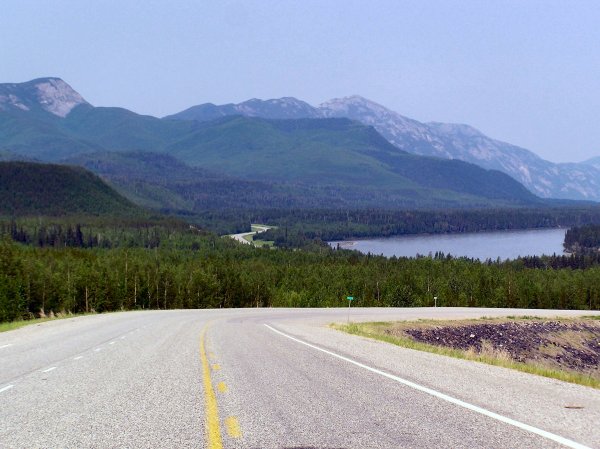
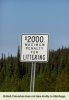 It's pleasant driving the Alaska Highway, at least in the
summertime. Breathtakingly scenic, it's lightly used and I often
go for long stretches without seeing another vehicle on the
road. Definitely no traffic jams. If several vehicles are in the
same place at the same time, it tends to be more like a social
event. People wave. Drivers will often slow down & pull over
to let another pass when they see they're being overtaken, this
being a 2-lane highway with a third, passing lane thrown in only
occasionally. Everybody is courteous. Nobody honks or yells.
It's pleasant driving the Alaska Highway, at least in the
summertime. Breathtakingly scenic, it's lightly used and I often
go for long stretches without seeing another vehicle on the
road. Definitely no traffic jams. If several vehicles are in the
same place at the same time, it tends to be more like a social
event. People wave. Drivers will often slow down & pull over
to let another pass when they see they're being overtaken, this
being a 2-lane highway with a third, passing lane thrown in only
occasionally. Everybody is courteous. Nobody honks or yells.
Sometimes
a crowd gathers because someone has stopped to watch an animal
along the roadside, which attracts the attention of the next
passerby who pulls over to see what it is, and so on. I've seen
half-a-dozen campers & cars pulled onto the shoulder in the
middle of nowhere, some people out of their cars taking
photographs. Inevitably it slows other traffic that does not
choose to stop - the locals and the commercial truckers - but no
one seems to mind as long as the travel lanes are left clear.
Near
Disaster
The other
day I managed to stop traffic all by myself, and I damned near
lost my RV in the process. I was barreling along at around 65
mph when I spied an enormous bison, a buffalo, grazing along the
edge of the forest. I wanted a closer look, but by the
time I had come to a stop I was 100 yards or so beyond the
animal. So I backed up along the road's shoulder, something I've
done before when there isn't any traffic coming up behind me.
Unfortunately, I failed to notice that the shoulder, which was
wide enough where I had stopped, grew narrower behind me. In
fact, it dropped off steeply into a deep ravine. As I was
reversing, I suddenly felt the RV lean away from the road. I hit
the brakes and came to a halt just barely in time, with the
truck heeled to starboard at an alarming angle.
I tried
driving forward onto the wider shoulder again, but the RV
wouldn't budge. When I got out to see why, I discovered that the
shoulder, which had looked solid enough, was in fact very soft
along the rim of that slope. Both of my back tires had dug
themselves into furrows and spun vainly when I tried to drive
forward or back. The front tires had actually started sliding
down the hill and stopped only because they had each plowed up a
mound of earth and gravel sideways that was acting like a little
wall. That appeared to be all that was keeping the entire
vehicle from sliding down and dropping into the ravine below. In
fact, at the angle it was sitting, it would have taken very
little to topple it sideways, sending it rolling over into the
deep gully. I was on the verge of loosing my RV right then and
there and I didn't see any way to get myself out of the
predicament.
Cars and
RV's came along. Some passed by slowly. Some stopped to offer
suggestions - mostly that I had better get a tow truck out
there. The nearest one, I gathered, was about 100 miles away in
Watson Lake. It would take a couple of hours for someone to get
there and send help, and a couple more hours for the tow to
arrive. I didn't think my RV would sit at that precarious angle
for another 5 minutes, let alone 4 hours. It appeared ready to
topple at any moment.
I managed
to get a shovel and some plywood out of a side locker and tried
digging out the back tires, using the plywood to give them
traction. But when I put the engine in reverse the tires just
dug in deeper and the van seemed even closer to falling over and
tumbling down the hill.
I stood by
the side of the road, dismayed and disbelieving, thinking my
great Northwest adventure was about to come to an ignominious
end right then and there. There was no question whatsoever that
the RV would be totaled if it fell into that ravine. What a
bummer!
Then
salvation arrived in the form of a couple from Indiana driving a
very big, bus-like RV. The guy graciously offered to pull me out
of there and I readily accepted. I had to scramble under the
downhill side of my truck and get into a locker to retrieve a
heavy rope I carried there. I knew I was in danger of being
crushed if the van tipped over right then, but it didn't and I
soon had the line tied securely to my camper's rear end.
Meanwhile, the couple with the big RV drove down the highway and
found a clearing where they could pull off and un-hitch the car
they were towing. By the time they returned I was ready for
them.
The man
backed up his rig so that it was close behind mine and I
fastened the 1-inch nylon line to his tow ball with a bowline.
He said, "Just so we understand each other, if your RV
falls over and down that hill while I'm trying to pull it out of
there, it ain't my fault. Agreed?" I agreed, and we went at
it.
His bus
was angled diagonally to pull my van back onto the road, so at
that point it was blocking the entire Alaska Highway in both
directions. Half a dozen cars & RV's and at least one
18-wheeler were stopped in one lane or the other, northbound and
southbound, their occupants patiently watching the show and
probably laying odds for or against my camper falling over
before we got it out of there. It sure looked like it could go
either way.
My rescuer
didn't waste any time. He climbed up into his big rig and pulled
forward, his RV's powerful diesel engine hardly noticing the
weight of my 24' truck. My front wheels began to slide downhill
and for a moment I thought all was lost, but he accelerated at
the critical moment and suddenly my van was up on the highway's
pavement and rolling backwards. He stopped, the towline went
slack, my truck kept going. It was about a second and a half
away from rolling into the rear end of the my rescuer's RV.
There was not time to open the door to my cab. I literally dove
through the open window, squirmed around in a heartbeat, and
jammed my foot down onto the brake pedal just in time to avoid a
collision. And with that grand finale, it was over.
I was
vaguely aware of people applauding from the backed-up traffic.
The guy that had saved my butt came out and I gave him a big
hug. I felt like a man who had just gotten a stay of execution
at the 11th hour.
|
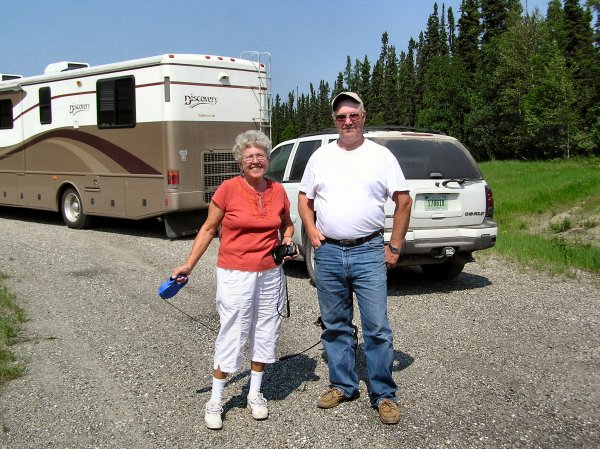
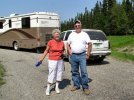
Later,
I met up with my rescuers at the pull-off where they
had left their car and I got to thank them again and
snap their photograph. His name is Jerald Call and
he's an auctioneer by trade (www.jcallnorthpond.com).
Wherever those good people are today I wish them every
wonderful thing in the world. Their timely and
selfless act saved my whole trip from almost certain
disaster.
|
 |
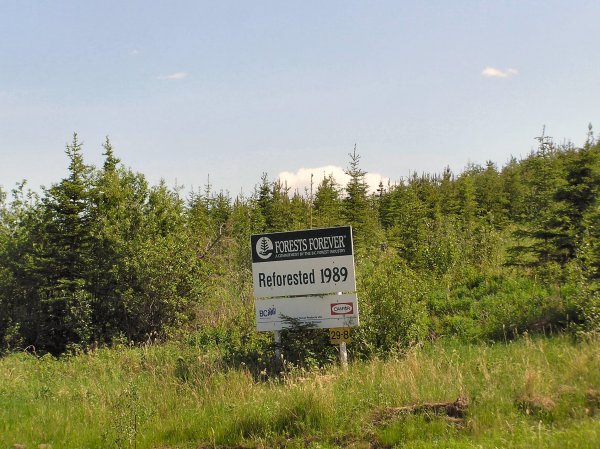
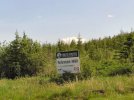 As beautiful as this country is, everywhere I travel up here I
find more evidence of the wholesale slaughter of our forests by
the damned lumber companies. I know I said my piece on this
subject in my last travelogue page and I promise not to belabor
the issue, but here they actually posted a sign bragging that
they have replanted the forest for us (or, more likely, for
themselves so they can cut it down again in 50 years). How nice.
See how deep and inviting their forest is after 15 years.
"Forests Forever." Thanks, assholes!
As beautiful as this country is, everywhere I travel up here I
find more evidence of the wholesale slaughter of our forests by
the damned lumber companies. I know I said my piece on this
subject in my last travelogue page and I promise not to belabor
the issue, but here they actually posted a sign bragging that
they have replanted the forest for us (or, more likely, for
themselves so they can cut it down again in 50 years). How nice.
See how deep and inviting their forest is after 15 years.
"Forests Forever." Thanks, assholes!
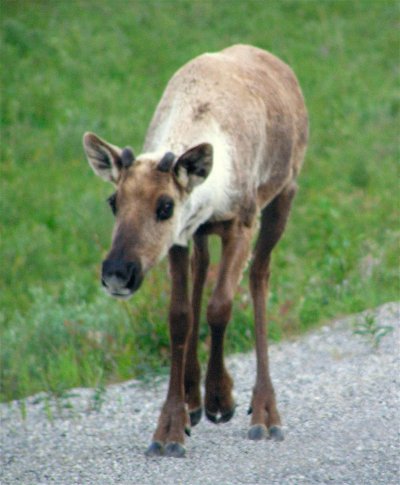
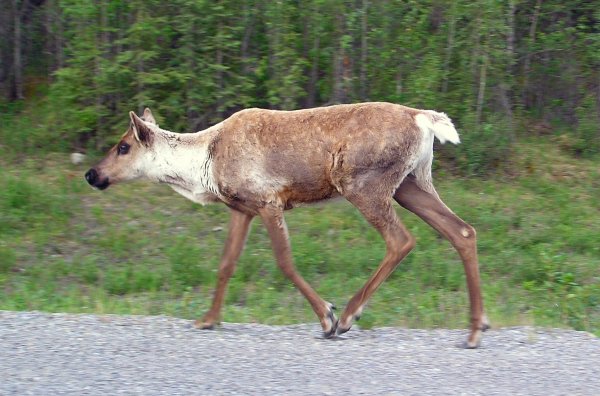
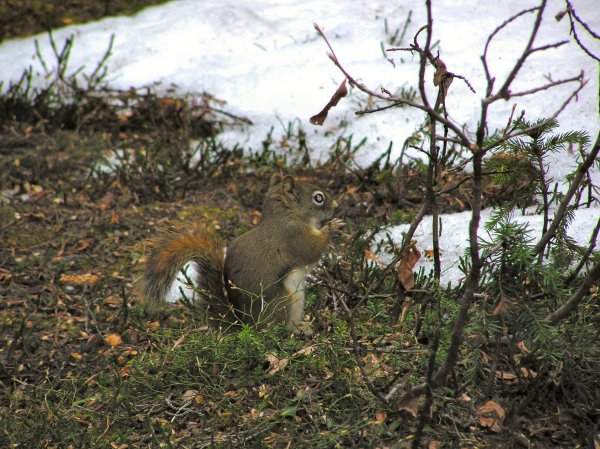
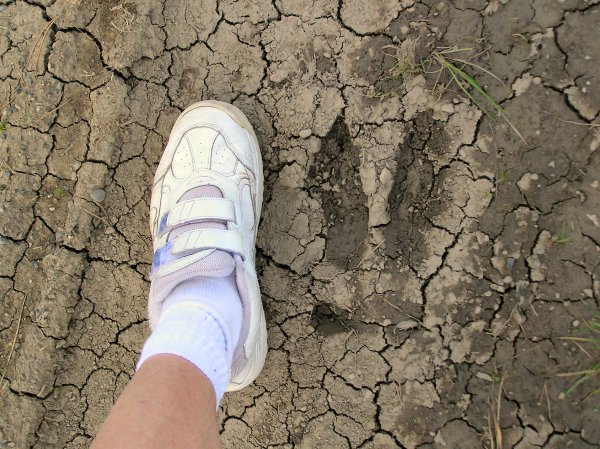
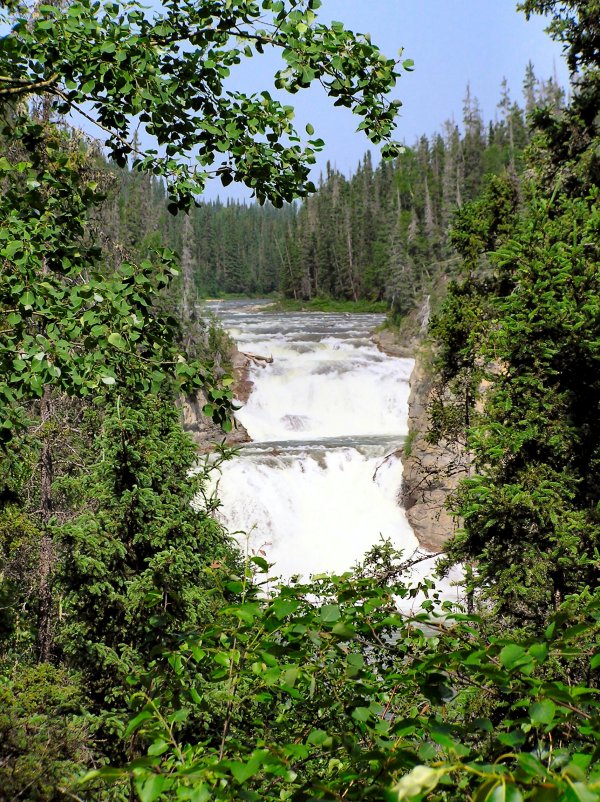
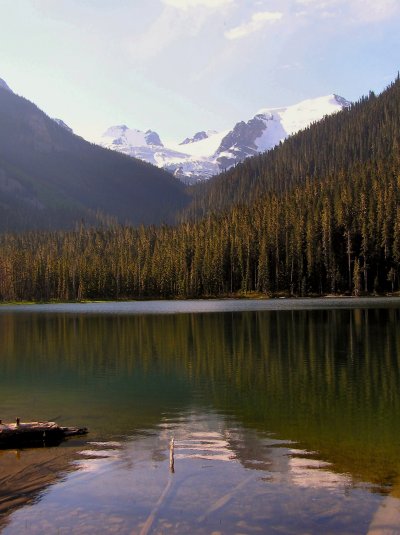
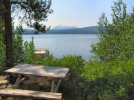
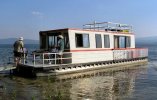
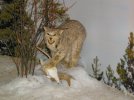
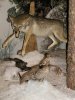
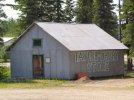
In spite
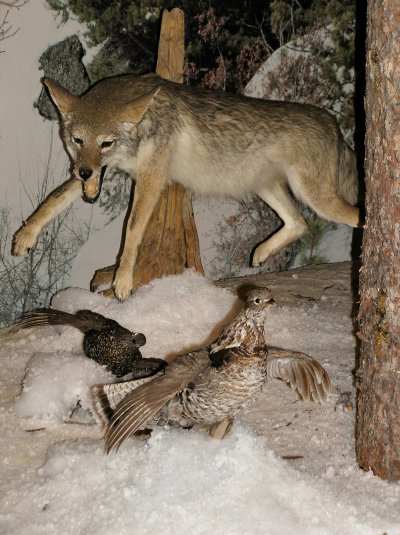
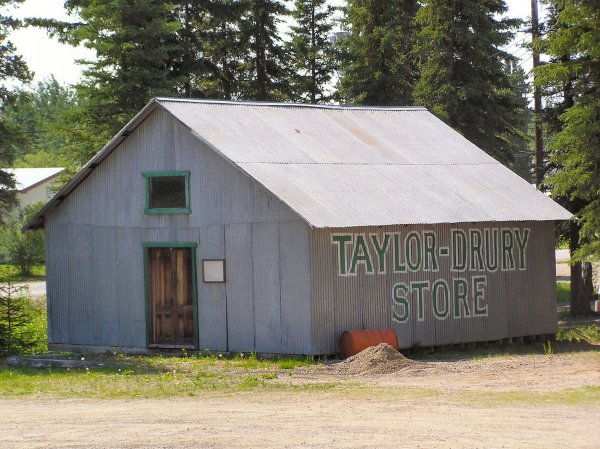
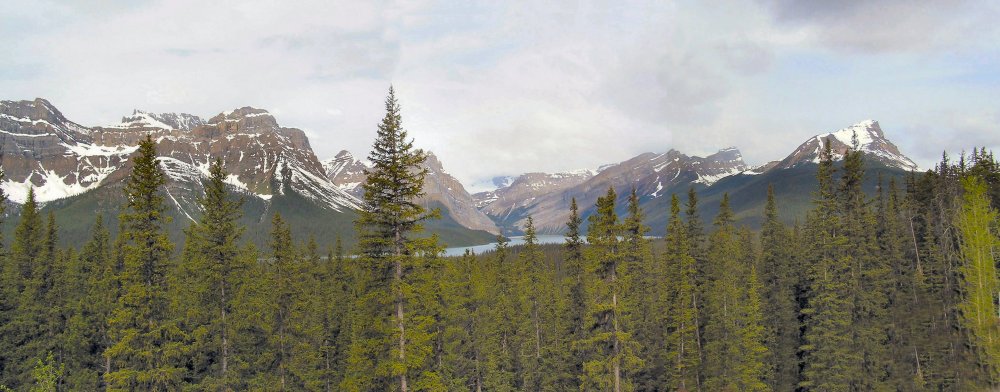
of those jerks, there is still abundant wildlife and beauty to
be found in western Canada. Here are a few scenes from British
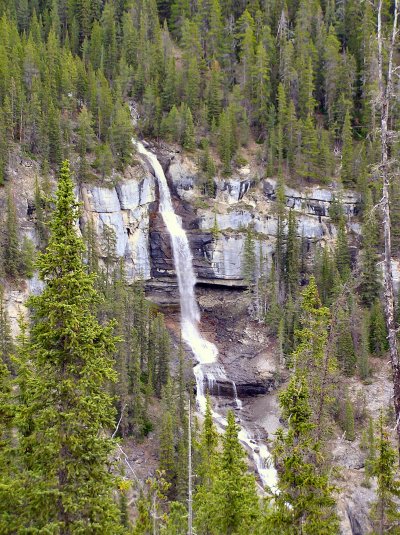
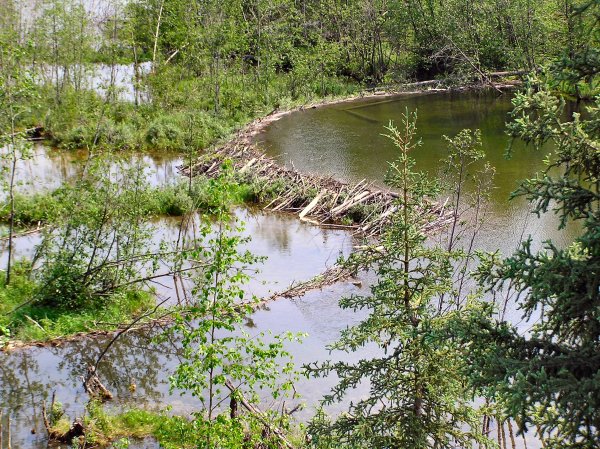
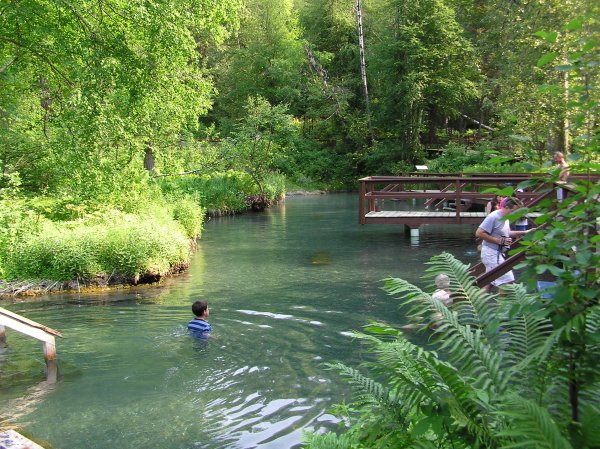
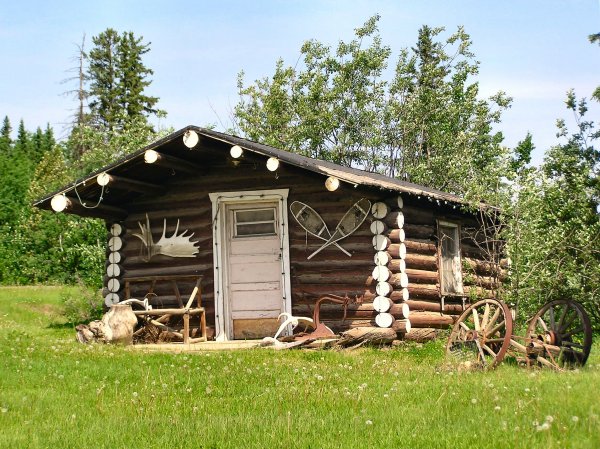
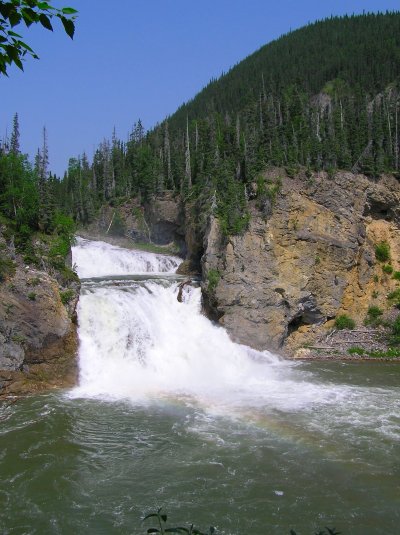
Columbia, Alberta (Banff & Jasper), and the Yukon.
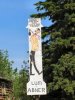
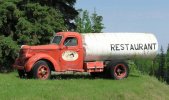
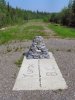
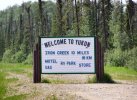
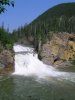
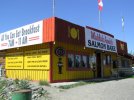
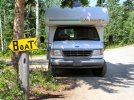
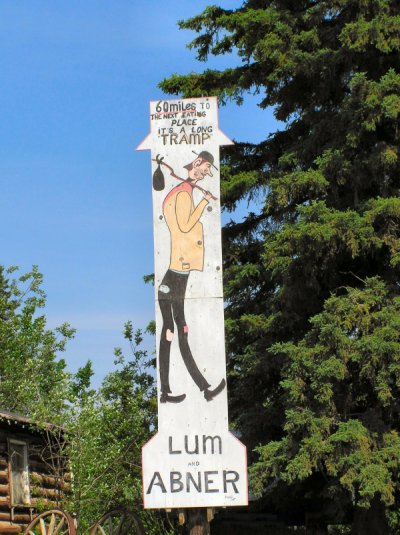
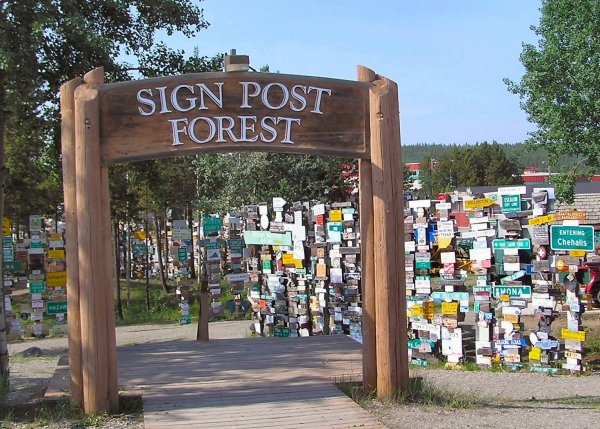
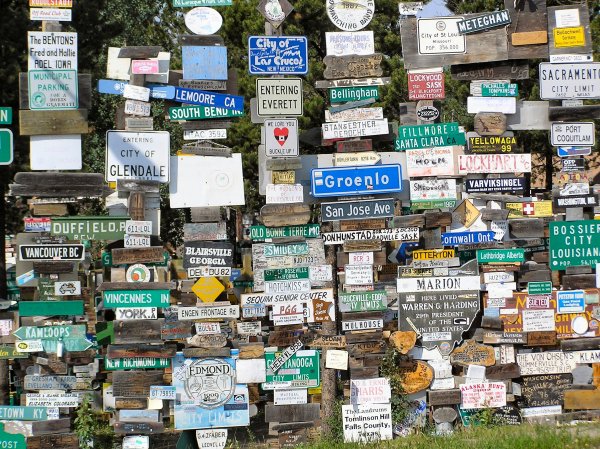
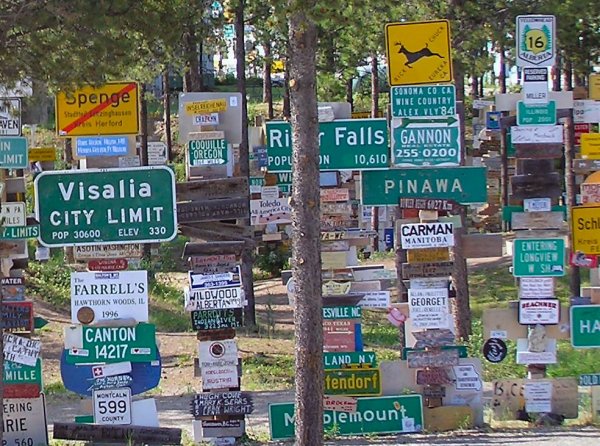
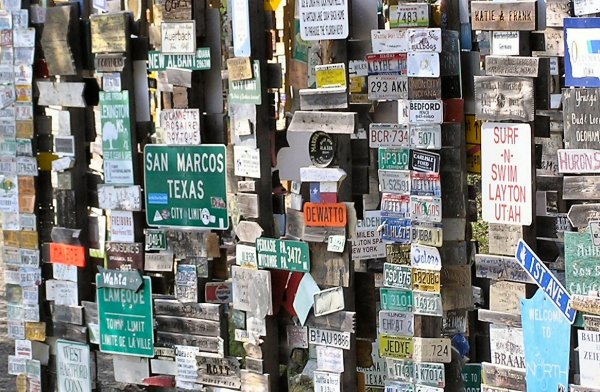
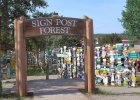
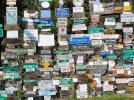
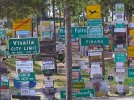
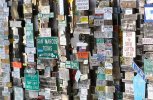
Sign Post
Forest, Watson Lake, Yukon
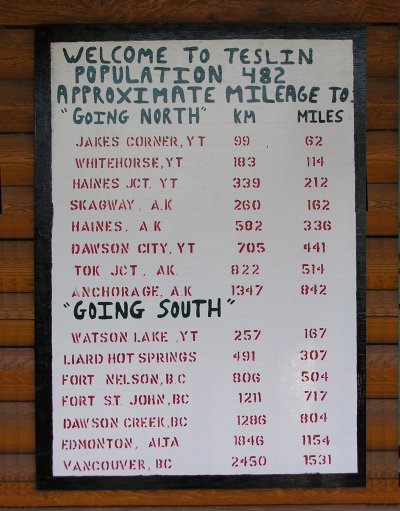
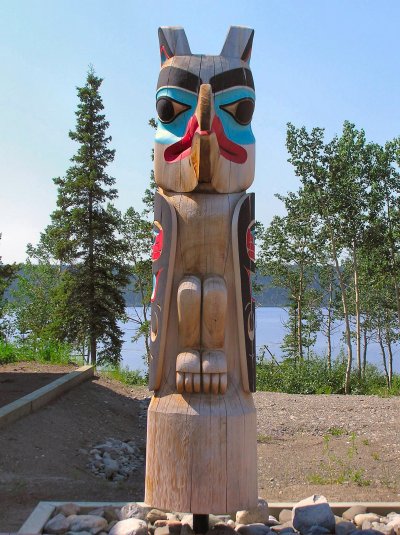
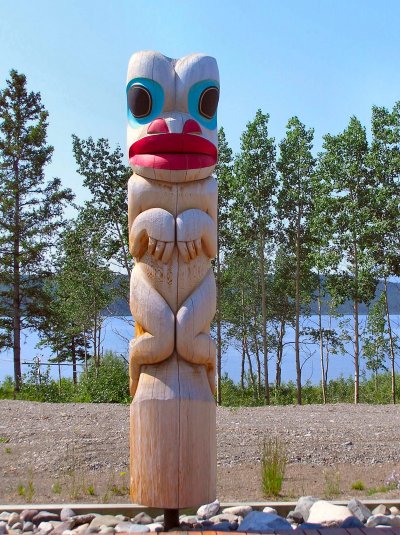
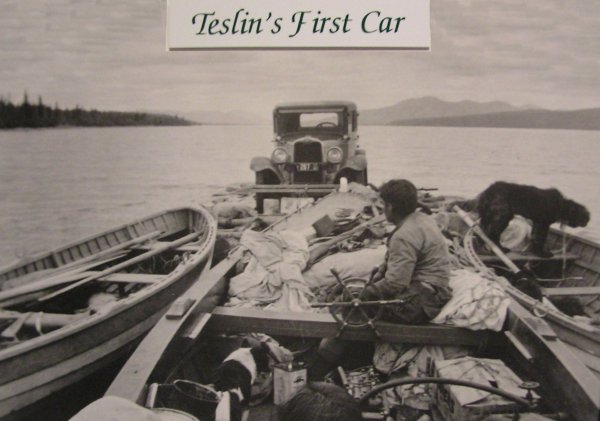
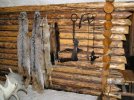
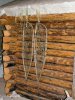
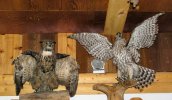
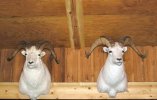
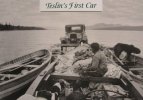
The George
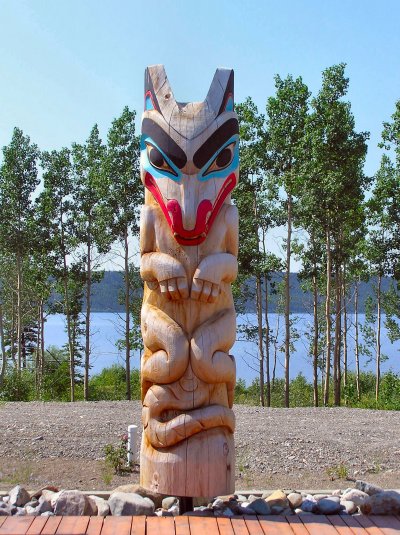
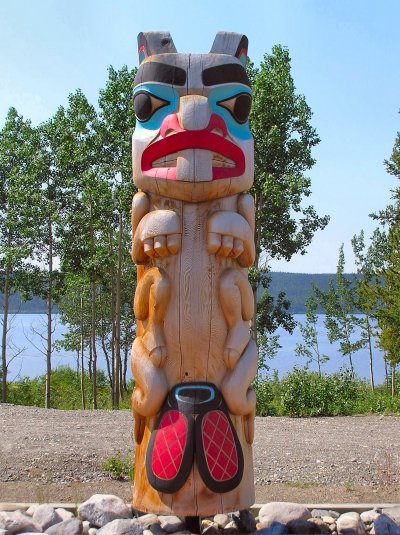
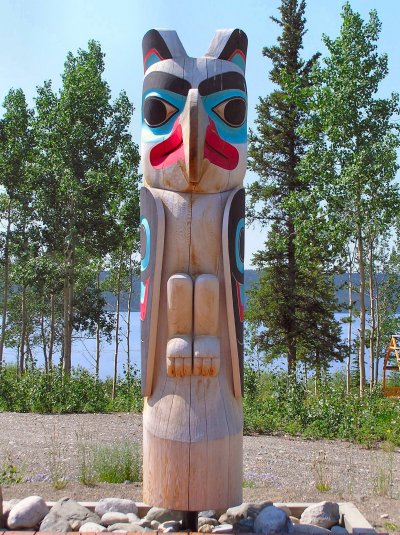
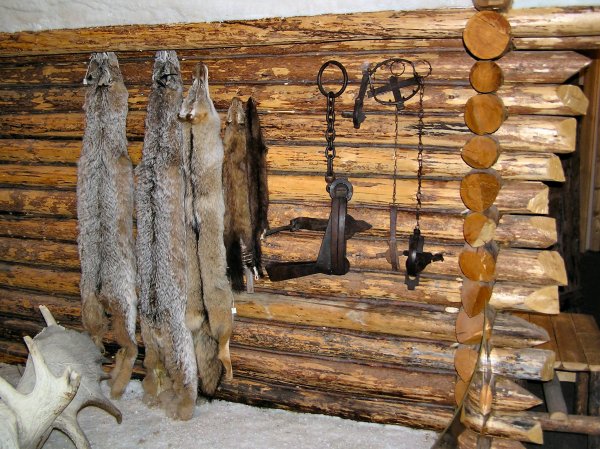
Johnston Museum and Keith Wolfe Smarch's Tlingit Totems in
Teslin, Yukon
Bzzzzzz
My RV has
a leak. It doesn't leak all the time, only when there's a swarm.
Yes, I said swarm not storm, because it's not water that's
getting in. It's mosquitoes. The infamous, ubiquitous, ravenous
Yukon/Alaska mosquitoes that can engulf a land-cruising vessel
like mine as ferociously as any storm at sea ever besieged a
sailing ship. These devils are a fact of life up here, one that
shouldn't be too difficult to live with as long as you've got
the requisite screens & repellents. Alas, for the slower
among us there is a learning curve and mine just got started the
other night.
I had
stopped to sleep at a roadside pull-off, a patch of bare ground
cleared from the surrounding forest. It dipped down abruptly
from the Alaska Highway's shoulder and led away maybe 100 meters
to a level parking spot alongside a babbling creek. Well, before
the night was through I was a babbling idiot, jumping out of bed
over and over again to go on killing rampages throughout my
little cabin's interior, slapping, whacking and otherwise
exterminating as many as possible of the dozens of mosquitoes
that had somehow, somewhere found their way inside.
But I
digress.
When I'd
first arrived in this campsite the bugs weren't too bad. There
was the usual forest mix of big and little flies, assorted other
insects, and of course some mosquitoes, but not too many to
handle. Pretty much what I've gotten used to up here. Anyway, I
didn't spend much time outside that evening, what with preparing
and eating supper & all. Soon after that I went to bed,
noting offhandedly the buildup of mosquitoes on the window
screens.
It was a
hot evening. It has been in the 90's everyday since I got to the
Yukon, a phenomenon that is breaking the weather records here
and positively wilting the unaccustomed locals. So I had all my
RV's windows open, all well-screened, and I was sleeping au
natural & without covers.
I hadn't
been asleep an hour when they attacked, buzzing and biting me
awake. It was a call to action that I could not ignore! I jumped
up and hopped around naked, cursing and swatting as many of the
little bastards as I could find. Finally, satisfied that I had
gotten most of them, I covered myself head to toe with a sheet
and went back to sleep. But that wasn't the end of it. More
mosquitoes arrived and they all converged on the only fresh
blood for miles around. Me. Their buzzing just beyond the sheet
I had over my head was loud enough to awaken me over and over
again, and some of them were actually managing to sting right
through it, but it was too damned hot to be under a blanket.
By then
the screens were covered with the black vampire hoards beating
their wings and gnashing their fangs against those frail nylon
threads that held them at bay. Had they somehow ever managed to
breech the barriers in force, I would surely have been drained
dry of all bodily fluids in a matter of minutes, an insectival
Night of the Living Dead. As it was, the screens seemed to be
doing their job. That wasn't where the bugs were getting in. In
fact, I'm still not sure where the leak is, but there is no
doubt it exists. Mosquitoes are getting into my van. Fortunately
the entrance also eludes the majority of the mosquitoes outside.
Otherwise I'd be sleeping in thick garments and blankets no
matter how hot it is, just to survive.
I was up a
lot that night, and when I slept it was entirely underneath
covers, sweltering. I burned mosquito coils and slurped on
insect repellent and they bit me less than before, but I didn't
get a very good night's rest. All through the next day, while I
drove and whenever I stopped, I was swatting remnant mosquitoes
as they emerged from dark corners and from behind lockers and
gear where they were hiding. All totaled I must've killed a
hundred that had gotten in during just that one episode.
I've got
to find that leak and seal it! Meanwhile, I'm shopping for a
mosquito bed tent today in Whitehorse.
Starless
in Whitehorse
Hearing
about the Land of the Midnight Sun and being here are two
different things. I understand scientifically what is happening,
but on some level I find the experience of it discomforting. The
sun rises around 4:00 am at this time of year at this latitude,
60°
north, and sets around 10:30 pm. That's no so bad, but after it
sets it doesn't go very far below the horizon, so that the sky
never gets dark. It's just several hours of twilight and then
the sun rises again. For most of the "night" you can
read a book by the natural light. I haven't seen a star in a
month. This has been a gradual process since I got to Canada, so
I can't say exactly when nighttime disappeared entirely, but
it's a daily fact of life now.
I miss
seeing stars at night. I really do. But I'm sure I would like
the winter alternative - all night and no sun at all - even
less. Of course, these day/night extremes are normal for people
who have grown up here and it doesn't bother them. For
transplants it varies. Many develop psychological problems and
start drinking heavily. For me, a temporary transient, it's an
experience and tolerable as that, but it's not my preference.
I'll be glad to get a little closer to the equator again in the
fall.
Forest
Fires
Because of
the unusually hot, dry weather that is plaguing the Northwest,
there is an abnormal number of wildfires burning. Several
hundred big and small in BC and the Yukon combined, according to
the reports, triple the number at this same time last year. I
heard on the radio that a section of the Alaska Highway through
which I just passed a few days ago was closed yesterday because
a fire had reached it. This morning the sky is so smoky I can't
see the hills outside of town and the sun is a subdued, angry
red ball. Hopefully, that will at least alleviate the mid-day
head today.
Mileage
& fuel consumption notes
As of
mid-June, three months since leaving Rhode Island, I had driven
my RV 8,375 miles (from 51,774 to 60,150 miles on the odometer),
passing through 19 of the United States and 3 Canadian provinces
and consuming about 1,000 gallons of gasoline at a cost of more
than $2,000 USD. Had I made this same trip a year ago, that gas
bill would have been about $1,300, so while I do cringe a little
each time I fill up the RV's big tank, the fact is these
inflated gasoline prices are not costing me so dearly that I
would change my plans because of them.
Canadian
gas prices are averaging around $.97 CAD per liter, which
amounts to about $2.68 USD per gallon figuring in the
current exchange rate. Forty percent of that price is Canadian
taxes. On the bright side, they say I can reclaim 7% when I
leave the country. The Canadian government offers to reimburse
their 7% GST, the Goods & Services Tax, to non-residents
after they've left the country if they'll mail in a form and the
receipts proving how much of the tax they've paid. It was worth
a hundred dollars to me so I did it.
I hear
gasoline costs between US$1.75 and US$2.00 per gallon in Alaska.
That'll be a relief after Canada's tax-inflated prices.
Next Entry: 07/03/04