CRUISING
(AND HIKING!) GRENADA
©
1993 Tor Pinney - All Rights Reserved
Funny
how one cruiser will just pass through a place, while another
stops and stays. The transient catches a glimpse and leaves with
an impression. The one who lingers lives an experience and
leaves with regret. Such is the nature of anchorages in
paradise; so it is in Grenada.
|
For
sailors on the move, the Windward Island of Grenada
(pronounced GRA-NAY-DA) in the southeastern corner of
the Caribbean offers snug harbors and reasonable
provisioning; a crossroads for yachts heading on to
Trinidad, back through the Lesser Antilles, or
downwind to Venezuela.
In
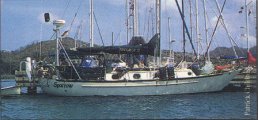
my case, Grenada presented an attractive landfall
after Sparrow's Atlantic crossing from the
Canary Islands. Having by then sailed 6,000 nautical
miles from Turkey, through a succession of autumn
gales in the Mediterranean and the East Atlantic, I
found Grenada's tranquility, warmth and charm
irresistible. The island and the people radiate a
heartfelt welcome that captivates anyone who stays
long enough to notice. It's a place where boat awnings
go up and stay up, and the anchor chain has time to
sprout a few barnacles.
Grenada
is an independent island nation, which also includes
the smaller islands of Carriacou and Petit Martinique,
and a number of islets. Grenada itself measures only
about 24 miles by 11, yet it seems much bigger. This
impression is probably due to the rugged mountain
range that forms the island's core, and to the time it
takes to travel overland on the convoluted mountain
roads.
The
mountains, lying directly in the path of the Northeast trade
winds, wring from the moist sea air more than 160-inches of
rainfall annually. As a result, most of the island is
unbelievably lush and verdant. In fact, Mother Nature has gone
absolutely wild here! Mango, papaya, orange, banana, breadfruit,
grapefruit, sugar cane, soursop, sapodilla, coconut, calabash,
coffee, cocoa, clove, cinnamon, allspice, thyme and nutmeg
abound. No wonder Grenada is called the Isle of Spice!
|
 |
Here
too, for cruisers wanting a break from daily boat life, is a
hiker's paradise. The interior mountains and foothills are
carpeted with primeval rain forest laced with streams,
waterfalls and trails. The fragrance of frangipani mingles with
wild spices and the musk of rich soil, while hibiscus,
bougainvillea, and heliconia everywhere delight the eye. Truly,
Grenada is a land blessed with stunning natural beauty.
But
above all, it's the people that make Grenada so special. Their
natural courtesy and open friendliness towards visitors is the
island's greatest national treasure. This feeling of being
welcomed is so prevalent that it takes a bit of getting used to!
Grenada hasn't yet suffered the tourist overload that strains
local attitudes in more popular vacation islands. It's a
refreshing respite for cruising sailors who have run the gamut
south from the States; the kind of place where a traveler
breathes a sigh of relief.
I
suppose most people, when they think of Grenada, immediately
recall the U.S. armed intervention. Some still think of this
little island as some kind of a war zone. Nothing could be
farther from the truth! What happened was, five years after
Grenada gained its national independence in 1974, an attempt was
made to set up a socialist/communist state. But things went awry
and in 1983, at the request of the Governor General, the United
States, Barbados and the Eastern Caribbean States intervened
militarily and launched the now famous "rescue
mission" which instantly ousted the communist leaders and
their Cuban advisors. Since then, Grenada's people and their
democratically elected government have extended an especially
warm welcome to Americans and to visitors in general.
Grenada's
turbulent history actually dates back to the defeat of the first
known inhabitants, the Arawak Indians, by fierce, cannibalistic
Carib warriors from the south. The Caribs were in turn
exterminated by French soldiers in the 17th century, who were
afterwards driven out by the English. Both the French and the
English imported black African slaves whose descendents rebelled
and eventually inherited the land. Today, Grenada has stabilized
and offers a safe port of call to a growing number of cruising
sailors and charterers.
 |
Arriving
in Grenada by yacht is relatively painless. Customs
and Immigration formalities are fast and free in the
town of Hillsboro on Carriacou Island, and in both St.
George's and Prickly Bay on Grenada. Unlike most other
formerly British islands, Grenada does allow pets to
enter once proper certificates of vaccination are
shown, though they may require a local veterinarian to
inspect the animal.
|
|
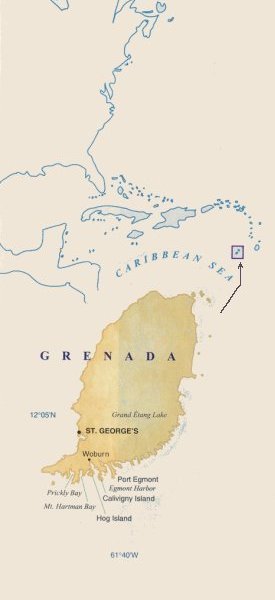
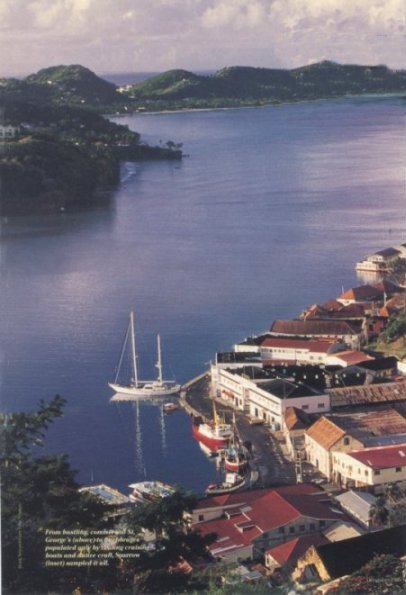
Grenada
boasts a dozen fine anchorages ranging from busy St. George's to
uninhabited coves along the south coast. St. George's, the
capital, has one of the finest commercial harbors in the Lesser
Antilles. A separate, landlocked inner harbor, "The
Lagoon", is reserved for yachts. Bordered by a perimeter
road, the harbor is a bit noisy, and you wouldn't want to swim
in the water there. But the aging marina, Grenada Yacht
Services, has docks and facilities, and an especially good
machine and engineering shop a block away. There are also
mechanics, electricians and a chandlery.
From
the yacht harbor it's just a minute by dinghy to The Carenage,
the downtown sea wall, where food markets, hardware stores, and
all manner of shops are close at hand. To make life even easier,
Federal Express and DHL can deliver parcels overnight, the
public phones feature USA Direct dialing (dial 872), Visa and
American Express are widely accepted, and there are several
embassies and consulates present (including U.S. and, in case
you're sailing in that direction, Venezuelan)
|
|
.
|
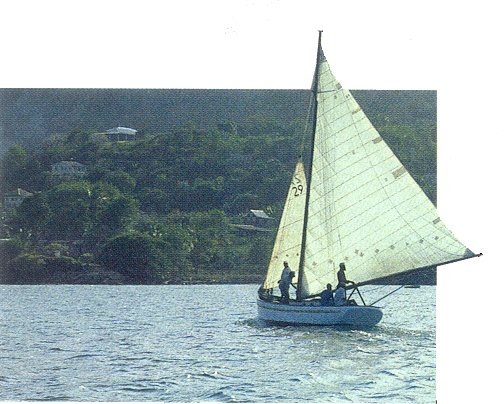
Once
you've run your downtown errands, a series of cleaner,
quieter anchorages beckon along the island's south
shore. Rounding Grenada's southwest point and heading
to windward, the first likely stop is Prickly Bay.
There a Customs/Immigration outpost nestles among palm
trees near the Spice Island Boat Yard. Yachts can haul
out at the yard for bottom work, and the pier provides
water, fuel and limited berthing. The restaurant and
bar at Spice Island is a social center for yachties,
featuring daily happy hours and live steel band and
reggae music on the weekends when sailors and locals
dance the meringue barefoot by the bay beneath swaying
palms and starry skies.
|
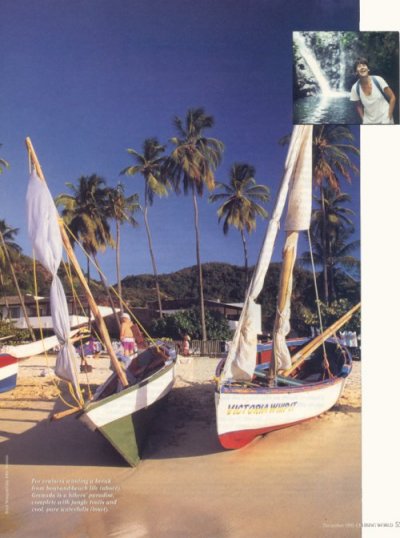 |
Next
to windward is Mt. Hardman Bay, renamed Secret Harbor by The
Moorings who have built a beautiful hideaway resort alongside
their modern charter boat marina. This marina is a secure place
to leave a boat dockside if you have to fly home for a visit.
The Moorings management is extremely helpful to visiting
yachtsmen, providing not only fuel, water and berthing, but also
serving as a mail drop and message center complete with phone
and fax service.
Our
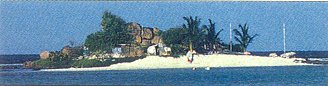
favorite Grenadian anchorage is in the lee of Hog Island,
immediately east of Secret Harbor. This small, uninhabited
island lies barely a quarter mile off the south coast of
Grenada. A developer is petitioning to build a hotel and marina
here; local environmentalists are fighting to prevent it. In any
case, it's all ours for now! Well, ours and a herd of goats'.
From
the anchorage it's just a 10-minute dinghy ride to the native
hamlet of Woburn, where you can catch one of the island
mini-busses into St. George's for EC $1.25 (one dollar Eastern
Caribbean currency = 37¢ US). These busses, Japanese mini-vans,
are the island's basic public transportation and a cultural
experience in themselves. Each is armed with a monster stereo
booming out the new reggae-rap music, called
"ragamuffin". Passengers are packed in like sardines,
but everyone is courteous and the ride is fast and cheap.
Our
neighbors in the anchorage are a medley of cruising sailors of
diverse nationalities, ten to twenty boats here at a time.
There's a nucleus of fellow liveaboards who, like us, are
staying "for awhile". This gives the place a feeling
of continuity, of neighborhood. At times, an informal morning
cruisers' net springs up on VHF radio channel 72, the cruisers'
monitored frequency, to share information useful to our unique
community.
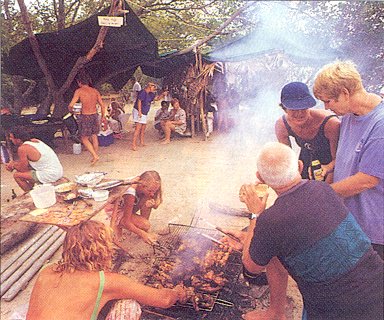 |
On
Sunday afternoons the sailors gather for a pot luck
dinner on the white sand beach 50 yards off Sparrow's
bow. Everyone brings one dish to share, plus any fish,
foul or quadruped they want to barbecue for themselves
on the driftwood fire. A couple of young local men
come by boat from the village bringing a tape player
loaded with reggae music and a cooler-full of beers
and soft drinks to sell under a palm-thatched lean-to.
Sometimes
on a Friday, they'll come out and cook a native dish made from
seafood they've just caught. Our favorite is something they call
"lambi oil-down", a spiced conch gumbo served over
rice. A heaping plate-full sells for $10 EC ($3.75 US); the cold
Carib beers are a buck. Livin' is easy here, mon!
|
There
are more remote anchorages east of Hog Island; such as in the
lee of uninhabited Calivigny Island, where a boat can lie alone,
the crew free to dive the reefs and comb virgin beaches.
Off-lying reefs shelter much of the south coast and the
gunkholing is outstanding, if a bit tricky. An excellent,
landlocked hurricane hole could be had in Port Egmont, though
Grenada lies a bit south of the hurricane belt and tropical
storms are very rare.
There's
a great deal to see inland on Grenada, as well! Through the
cruisers' VHF net, it's easy to gather a group of like-minded
mariners to share the cost of a chauffeured island tour in a
private mini-bus. This is probably the best (and cheapest) way
to see the popular sights such as the majestic Concord and
Annandale waterfalls, the botanical gardens, the volcanic crater
lake Grand Etang, the spice plantations and rum distilleries,
and the small villages scattered throughout the island.
For
nature lovers, the real magic and beauty of Grenada awaits in
the mountain rain forests. Scores of trails meander throughout
the island's 3,000-acre National Forest Preserve. The Grenada
National Parks Nature Center in the central mountains provides
information and trail maps. Guides can be hired through various
tour operators, but you don't necessarily have to have a guide
to go hiking. There are some well-marked nature trails right
around the Nature Center. More adventurous outdoorsmen can pack
a picnic lunch, catch a bus inland and, trail map in hand, spend
an extraordinary day discovering their own Garden of Eden
including hidden waterfalls deep within the tropical jungle.
The
Qua Qua trail is one of these treks, a 5 to 8 hour hike that
begins high in the mountains at Grand Etang Lake. Cupped in the
crater of a dormant volcano, Grand Etang itself is shrouded in
mystery and legend. There's the unlikely story of a scuba diver
who descended, intending to disprove the locals' claim that the
lake is bottomless. He never again surfaced from the sepia
depths; they say his drowned body washed ashore on the island of
St. Lucia, a hundred miles away.
From
the lake, the Qua Qua Trail rises steeply to straddle the
knife-edge of a long ridge. Cliffs disguised under thick forest
cover drop off either side of a path barely two feet wide in
places - not a walk for the fainthearted or acrophobic! This
high ground provides awesome panoramic views: north to the
highest peak of Mount St. Catherine, south to the silent crater
lake, east to the distant port town of Grenville on the Atlantic
coast, and west to the shimmering Caribbean. The trail then
hovers at the peak of Mount Qua Qua among a windswept elfin
woodland before plunging down the western slope into the deep
forest.
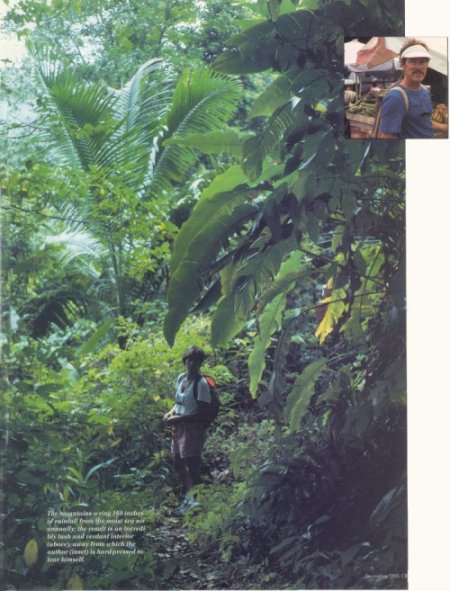
The
tropical mountain rain forest is a cool, timeless world of
diffused light and padded sound. The hush is pierced by the
shrill of highland piping frogs, the occasional melody of a
yellow-billed cuckoo, or the startling flutter of hummingbird
wings. In the background whispers running water and the eerie
creaking of giant bamboo thickets swaying in the zephyr. Aloft
in the forest canopy African Mona monkeys play, and down in the
ravines trickle the limpid headwaters of the Black Bay River.
Creeks merge and form the mountain stream; the stone-and-boulder
bed provides endless natural bathing pools. The Qua Qua Trail
weaves a graceful dance with this young river, crossing and
re-crossing it amid an astonishing variety of exotic flora.
There are no dangerous animals and surprisingly few mosquitoes.
|
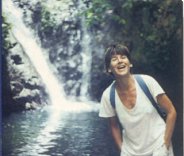
In
a dramatic climax, the trail drops steeply to an
upcountry nutmeg grove. Just beyond, the Upper Concord
Waterfall bursts from the mountain side, cascades over
a rocky precipice and carves a deep swimming pool
below in a fairyland setting of ferns and mosses. Here
the hiker rests - a rest that soothes the soul as much
as the body. Even as the sun settles westward, urging
you back to the boat, it's awfully hard to tear
yourself away!
|
 |
 |
And
so it is with Grenada; it's a hard place to leave.
Grenada doesn't yet offer the glitter of some of its
northern neighbors; there are no discos; no casinos.
But if you're looking for a bit of the "old"
Caribbean much the way it used to be - where the trade
winds are steady, the livin' is easy, and the natives
are glad to meet you - then this is a place you've got
to see. For lucky mariners who make it to this
farthest corner of the West Indies, Grenada promises
all the delights of a tropical sailor's dreams.
|
Key
to Map Locations
Island
Map:
1) HILLSBOROUGH,
CARRIACOU - Northern-most Grenada Customs & Immigration
office
2) ST. GEORGE'S -
Grenada's capital has a protected yacht anchorage, Customs &
Immigration, GYS boatyard and downtown shopping (see St.
George's map & key)
3) PRICKLY BAY -
Southern-most Grenada Customs & Immigration office, Spice
Island Boat Yard
4) MT. HARTMAN
HARBOR (A.K.A. SECRET HARBOR) - Home of The Moorings charter
fleet marina & resort
5) HOG ISLAND
ANCHORAGE - A favorite among cruisers
6) WOBURN - The
village serving as land base to boats at Hog Island anchorage
7) CALIVIGNY
ISLAND - Offers isolated anchorage on its lee side
8) PORT EGMONT -
The inner harbor is an excellent hurricane hole - the best
around!
9) GRENVILLE -
Grenada's second largest town, its reef-protected harbor is used
mainly by native vessels
10) CONCORD FALLS
- Very impressive water falls
11) GRAND ETANG
LAKE - Mysterious crater lake in the central mountains
12) NATIONAL
PARKS CENTER - Provides information and trail maps
St. George's
Map::
A) THE LAGOON -
The yacht anchorage
B) GRENADA
CUSTOMS & IMMIGRATION OFFICE
C) GYS (GRENADA
YACHT SERVICES) - Boat yard and marina
D) DOWNTOWN ST.
GEORGE'S - Shops and services
~
End ~
Back
to List of Tor's Tips
