DINGHY
DANGLING
©
1990 Tor Pinney - All Rights Reserved
Wrestling a
capsized dinghy offshore in heavy seas, the boat rolling
like a drunken sailor, my mate throwing up, the dog barking
and the seas breaking.
That's when the painter snapped.
|
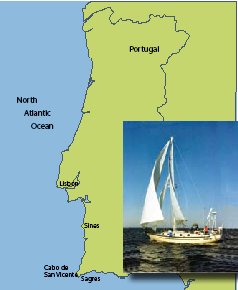
We slipped Sparrow's
moorings by the light of the full moon and sailed from the
Portuguese fishermen's harbor of Sines. Dawn was almost a
hint in the eastern sky. Our next port of call, Sagres on
the Algarve coast, was 60-odd miles south and around the
southwestern-most point of mainland
Europe, desolate Cabo de San
Vicente. Today, with a rising barometer and a fair
northwesterly breeze, Sherrie and I looked forward to a
pleasant broad reach all the way. Ah, but fair winds alone
do not a smooth sail make - a fact that was about to
reassert itself in a most distressing and unexpected manner.
|
 |
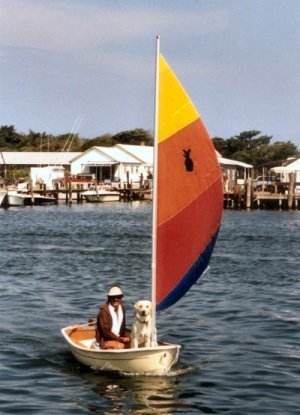 |
Close astern waddled
Sparrow's faithful tender, Tailfeather, an 8-foot Trinka
dinghy. She has one standard feature that I especially like,
a self-bailing scupper installed in her bilge that will
drain out water that splashes in underway. Thanks to this,
we’d been able to tow Tailfeather many thousands of miles
when cruising coastwise. It's more convenient than lifting
her onto the foredeck with a halyard for every little
harbor-hop, although that is, of course, standard procedure
for offshore passages.
Today's trip was a day
sail. So I gave little thought to the dinghy trailing astern
other than to pay out a bit more painter as we left the
harbor. Boy, was I about to learn something about prudent
seamanship! |
No sooner did we clear
the outer jetty than we discovered the swell. We could
hardly ignore it, for Sparrow immediately began the long,
exaggerated roll that is the inevitable result of big,
quartering seas. Like today's wind, the swell came from the
northwest, but this was no local, wind-generated sea. This
was a far-ranging ground swell, born of distant gales, way
out of proportion to the 12-15 knot breeze that wafted us
southward.
I estimated the largest
waves, which came in sets of three, to be 12-15 feet high.
They weren't threatening. They weren't even breaking. But
the crazy motion sent seasick-prone Sherrie to the lee rail
in a hurry, and thence below to her bunk. Down there with
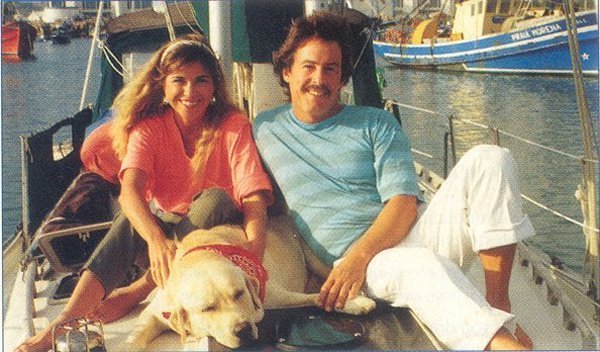
her was our seafaring, 85-lb. Labrador retriever, Shaolin.
When Sherrie feels under the weather like this, Shaolin
invariably comes to her aid by licking her face repeatedly.
He worries, you see. Anyway, he's warm and fluffy and
there's nothing like a little canine comfort when the seas
are up.
So I watched the
glorious sunrise alone, braced in the cockpit against the
ship's roll. Once or twice the dinghy skimmed forward on the
face of a wave, nearly catching up with Sparrow's transom. I
added another 20' of line to her painter and for the first
time wondered if it mightn't have been a good idea to have
hauled her up on deck after all.
By now, however, we were
miles in the offing. Soon the wind increased to around 20
knots and small, white-capped wavelets began cresting the
tops of some of the swells. We were in 50 fathoms 5 miles
offshore, broad reaching under just the genoa, paralleling
the Portuguese west coast. As the long ocean ground swell
felt the tug of the continental shelf below, it grew steep
and closed ranks. Through binoculars I witnessed the fury
with which the waves pounded the shore. Even out here an
occasional wind-bolstered swell would break and tumble over
itself, leaving a patch of white foam in its wake.
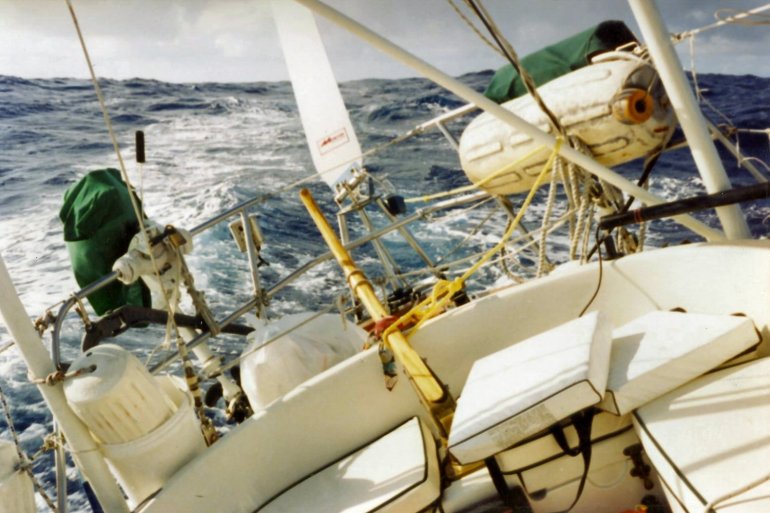
Letting the windvane
steer, I ducked below to see how Sherrie and Shaolin were
faring. As long as Sherrie was lying down her discomfort was
minimized. Shaolin seemed content just to be close at hand.
Then I thought I felt the boat slow down. At the same time,
I heard an odd creaking noise on deck, as if a line were
coming under great stress.
I hopped up into the
cockpit and glanced aft. There, looking like a small,
injured whale, was our dinghy dragging upside down behind
us. She must have broached to a breaking wave and been
rolled over, something that had never happened before. Now
the tow was forcing her bow down, creating an enormous drag,
a huge sea anchor, which slowed Sparrow to a crawl in spite
of the straining headsail.
What to do? It took me
several long seconds to even begin devising a plan of
action: 1) Stop the boat. 2) Get the dinghy righted. 3) Get
her bailed out. OK, go!
I released the genoa
sheet and furled the headsail. Sparrow immediately edged
broadside to the seas and, without the steadying effect of
the sail, rolled until her rails were nearly dipping port
and starboard. My mind was racing, scrambling for more
ideas.
I fired up the engine.
I called to Sherrie that
I needed a hand on deck. A moment later she appeared in the
companionway, grim faced, and I pointed to the cause for my
alarm bobbing in the waves close astern. I explained that I
intended to get the dinghy alongside, attach a halyard, and
lift it enough to turn it right side up. This sounded
logical enough, but oh, so much easier said than done.
In the fresh breeze
Sparrow was still making some way under bare poles, keeping
the dinghy painter taught. It was all I could do to inch
Tailfeather closer, hauling for all I was worth and braking
the sudden jerks and tugs on the line with fast wraps around
a cleat. I did my best to anticipate the rolls and surges,
but still lost a foot for every 18" gained. I alternately
called out orders and praise to Sherrie, who was manning the
helm and throttle, maneuvering Sparrow to keep the dink from
demolishing the windvane on the transom. I wondered whether
the oars, which I had wedged under the dink's seat, were
still there. And the teak floorboards - what a chore they'd
be to replace if they were lost. Well, I'd face that later.
Gradually,
painstakingly, Tailfeather came under Sparrow's lee. The
hulls repeatedly thumped one another as I fetched the main
halyard and fumbled to shackle it to a bight in the painter.
A rogue sea slopped over the combing into the cockpit,
soaking our feet and sloshing an assortment of lines into a
spaghetti-like jumble. The cockpit cushions added to the
confusion by sliding off the seats into the well. To clear
our working space, I grabbed anything that wasn't where it
belonged and tossed it down the companionway hatch onto the
cabin sole where the dog was poised, anxiously waiting to be
called to action. To his chagrin we left him below.
"OK, Sherrie, you crank
on the halyard winch; I'll guide the dinghy and try to get
her turned over." Sherrie acknowledged by moving into
position. She didn't look well at all, a distinct green aura
to her face and an unnatural tightness to the set of her
lips.
Still, she cranked
stoically and Tailfeather's bow rose from the sea. Suddenly
an oar slipped out from under the dinghy's seat, caught
momentarily under the rail, then popped to the surface,
drifting quickly away. But there was no time for that now.
The dinghy came farther
out of the water and, aided by a timely roll of the ship,
spilled out half the water that filled her. I somehow spun
her around as Sherrie eased off on the halyard. Tailfeather
landed upright in the water and, when I released the halyard
shackle, slid back into position aft. Almost as suddenly as
it had begun, it was over. Or so we thought. We even managed
to work Sparrow around under power to where I could snatch
the errant oar with a boat hook, yanking it neatly up to
within arm's reach. I held it up in triumph. Sherrie threw
up.
My mate retired
belowdecks to rest and console (and be consoled by) Shaolin
while I rolled out the genoa and got us underway again. I
was feeling pretty cocky at having so handily resolved a
potential disaster; we could ill afford to loose our ship's
tender. I was expecting the remainder of the water in the
dinghy to self-drain once we got moving and I looked back to
observe this process.
But what I saw instead
was that the dinghy wasn't towing properly at all. She was
sluggish and with so much water still sloshing around,
unbalanced. The self-bailing scupper couldn't empty her fast
enough. Each swell shoved the skiff awkwardly, twisting her
broadside while the pull of the towline dragged her
inexorably sideways. Then, to my utter dismay, she plowed
into a lumpy sea and submarined beneath the surface. A
moment later she rose, inverted again. Shit!
"Sherrie! I'm gonna'
need you up here again! Better hurry!" She came, bless her,
but it wasn't easy.
"This isn't working," I
said. "We're going to have to get the dink out of there
completely, haul her up on deck." This announcement evoked
little enthusiasm from the crew, but there was clearly no
other choice of action if we were to save our dinghy.
Sherrie made a quick dash for the lee rail and, finding
little left to disgorge, bravely took the helm again to
assist in the recovery.
Behind us, the second
oar appeared floating a few yards from the capsized dinghy.
It was immediately joined by one of the two teak floorboard
sections. I instructed Sherrie to turn
Sparrow around so I could recover these, meanwhile pulling with all my might on
the straining dinghy painter.
What followed was an
improbable series of maneuvers and acrobatics as the boat
rocked and pitched in the great seas. I heaved on the
painter, cursed, stabbed at the oar and floorboards with the
boat hook, and hauled some more. Sparrow's deck was a wild
place to work and I stubbed, bumped, scraped, chafed and
grunted my way about, a mad man on a bucking bronco.
Then it happened.
Suddenly there was no more resistance on the towline.
Sparrow shot forward; Tailfeather remained behind, and I
landed on my rump. The painter had parted.
OK, OK, let's see. Think!
Already Tailfeather was disappearing between the troughs of
the big waves.
"All right, Sherrie,
bring us around and ease alongside. I'll see if I can catch
the bow line with the hook."
She did as I asked, but
it was no good. The line was broken off just inches from the
dinghy's bow. There wasn't enough of it to pull up. Damn! So
much for Plan A.
I knew what I had to do,
although I didn't want to. Sherrie watched skeptically as I
rummaged in the lazarette, emerging with assorted dock lines
and snorkel gear.
"Here's the plan," I
said with more confidence than I felt. "I'll just hop in,
swim this heavy line over there, tie it to the dinghy's bow,
and we'll haul her in with that."
"I don't like it, not
one bit!" was Sherrie's only comment.
Well, hell! I didn't
either.
Nevertheless, replete
with mask, snorkel and flippers, I staggered to the rail.
Before I could have second thoughts, I plunged into the
chilly Atlantic Ocean. In no time I was at the dinghy,
surprised at how gentle the motion was now that I was
actually in the water rather than upon it. Because
Tailfeather's nose was angled down, I had to dive under to
tie on the new towline. When I surfaced a moment later I was
just a couple of feet from Sparrow's plunging stern. The
stainless steel windvane shaft stabbed dangerously close to
my skull. I kicked clear. Back alongside Sparrow I needed
only wait for the rail to roll down with the next wave to
easily, if gracelessly, belly flop onto the side deck.
Somehow we muscled
Tailfeather into Sparrow's lee for the second time. I put a
bight in the new towline, attached the staysail halyard, and
led the halyard to the powerful, two-speed jib sheet winch
in the cockpit where Sherrie, silent but determined, began
to crank. I stationed myself forward to guide the skiff.
Ever so slowly
Tailfeather rose. This might actually work! Just then, a
particularly big set of swells fell upon us. Sparrow got to
rolling so badly, water slopped over her rails. The dinghy,
dangling at the end of her tether, swung wildly out and away
from me. I clutched desperately at her with one hand, and
grasped a shroud with the other just in time to keep from
flipping myself overboard. Sparrow rolled back hard to
windward and the dinghy slammed into the ship's side next to
me.
"Crank faster!" I
shouted to my mate. "Faster!!"
Sherrie redoubled her
effort, leaning her whole body into the winch handle.
Without breaking her stride, she wretched and threw up and
then cranked harder. From belowdecks among the tossed
cockpit cushions and debris, Shaolin was barking
persistently, upset at being left out of whatever was going
on. Again the dinghy flew out to leeward; again it slammed
into Sparrow with terrific impact. The second floorboard
section flew out and floated away.
Sets of three, I thought.
Sure enough, ZOOM!
CRASH! Tailfeather did it again.
God, please don't let the halyard break!
It didn't. There was a
momentary lull after the three big ones; the seas eased off.
I grabbed the dinghy and wrestled her over the lifelines
onto the coach house. Sherrie eased off on the halyard and
Tailfeather settled down with uncharacteristic grace. We
manhandled her to her customary position on deck and it was
done!
But I confess it would
have been easier to do in harbor before we left.
|
My exhausted mate kindly
made no allusion to this, but went below to comfort Shaolin
and to sleep off the whole episode like a bad dream. I got
us moving again, somewhat bruised in body and soul. The rest
of the day was smooth sailing.
Incredibly, nothing was
broken, neither boats nor bones - a tribute to Lady Luck and
the sturdy construction of both Tailfeather and Sparrow. And
having eventually recovered all floating oars and
floorboards, nothing was lost. Well, an hour or so of
sailing time. And maybe just a bit of the captain's self
esteem. |
 |
~
End ~
Back
to List of Tor's Tales
