SON
OF A DAUGHTER OF A SAILOR
©
1992 Tor Pinney - All Rights Reserved
When
I was a boy growing up on the Long Island Sound in New York,
my Norwegian grandfather, whom we called "Morfar"
(meaning, literally, "mother's father"), would
sometimes recount his youthful sea adventures while I
listened, wide-eyed. Maybe those stories had something to do
with the fact that today, as I write this, I am captain of
my own stout sloop, aboard which I'm now sailing around the
world.
|
My
mother's father, Arnt Berthelsen, was a Norwegian
seaman in the early part of this century. Born the
son of a Mandal boat builder in 1900, he shipped
out of Oslo as a cabin boy at the age of fourteen
aboard one of the last working tall ships. For the
next decade or more, he ranged far and wide aboard
a variety of ocean-going vessels, eventually
becoming a captain.
In
the winter of 1916, my grandfather's ship, the
barque Sagitta, was making a gale-ridden
passage from Savannah, Georgia to Kallenburg,
Denmark, laden with ordinary cargo. The Great
World War was raging, and all hands were nervous
about passing through the heavily mined North Sea.
But it wasn't the mines that got them. They were
attacked by a German submarine, which suddenly
surfaced and opened fire with its heavy deck guns.
|
 |
At
the first salvo, a piece of steel ripped into my
grandfather's forehead, and he was nearly blinded by the
blood. Then, even as the Captain ordered the topsails backed
to heave the ship to, the submarine fired a torpedo. The
unarmed merchant vessel shook with the explosion. The Sagitta
was fatally holed, and a lifeboat was lowered as the
shattered 3-masted barque began to sink stern first into the
icy waters. Nineteen sailors - including the father of my
unborn mother - scrambled into the small boat and took to
the oars. The German sub stood off watching, never offering
rescue assistance.
My
grandfather and his mates soon found themselves alone in
their lifeboat on a freezing, storm-tossed ocean. There were
no supplies aboard and the weather was severe. Morfar spoke
of that time of suffering and tragic death:
"We
had nothing to eat; no water to drink. We rowed, those of us
who were able, day and night. We had brought a dog, our
beloved ship's mascot, into the lifeboat with us. One night
some of the men, half-crazed with hunger, cut his throat,
carved him up and ate him raw. Another night it snowed and
all of us, by then nearly dead of thirst, licked the
moisture off our sleeves and off the boat's rail, praying it
would snow harder! The cold and the suffering became
unendurable! During the five days and nights we were out
there, some of the men went mad with despair and killed
themselves, several by throwing themselves overboard to
drown; a couple by cutting their own throats. Others simply
froze to death. It was a horrible time. I kept rowing as
long as I could, afraid I might lose my mind, too, if I
stopped. I think the only reason I lived was because I was
one of the youngest. My resistance was a bit stronger than
the others, you see. Anyone over 17 or 18 years old just
didn't have the stamina to survive that exposure - the
bitter cold! So many died," he trailed off sadly.
Eventually,
the skiff washed up in a little fjord on the coast of
Norway, luckily near a village. A lone newspaper boy, out on
his morning delivery route, discovered the boat-full of
frozen bodies and sounded the alarm that brought help. At
first the townspeople thought that every one of the
castaways were dead. But they discovered that four young
men, covered in ice and blood, were still alive - just
barely.
|
|
The
event made headline news in the Norwegian papers.
There was shock and outrage at the German sinking
of the unarmed merchant ship, and the subsequent
loss of life. During a long hospital recovery,
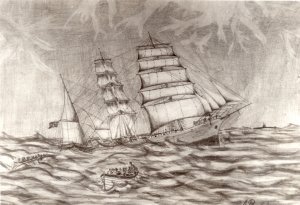
Morfar sketched with a rough artist's hand a
graphic portrait of the sinking of the barque, Sagitta,
as he remembered the scene from the lifeboat. In
the picture's background is silhouetted the black
German submarine.
|
My
mother now has that sketch framed and hanging in
her home. Someday it will be mine, then my
children's, and then their children's.
The
epilogue to this tale was my grandfather's favorite part of
the story. It was decades later, long after he and his young
Norwegian bride (you guessed it, my "Mormor") had
emigrated to America. They were living in Brooklyn, New
York, where a large community of Norwegian immigrants had
settled. Morfar was working at the Brooklyn Navy Yard and
commuted daily by subway. Naturally, there often were other
Norwegians on that train line. So he wasn't too surprised
when one day a Norwegian man he didn't know struck up a
conversation. As a newsboy passed through the train car
hawking papers, the man said, "You know, I was a
newsboy myself, in my village during World War I. As a
matter of fact, I was once a bit of a celebrity because of
it."
"Oh,
is that so?" answered my grandfather.
"Yes,"
boasted the man. "You might recall a big news story
back then, when the Germans sank one of our sailing merchant
ships? The survivors were discovered on the beach by a young
newsboy, you remember? Well, I was that boy who found them!
What do you think of that!"
My
grandfather just smiled and shook his head, momentarily
puzzling the self-proclaimed hero. Then Morfar exclaimed,
"Well it's good to see you again!" completely
baffling the gentleman. So he explained, "You see, I
was one of the four survivors you found in the lifeboat that
day! What do you think of that!"
And
so they had a grand reunion aboard a New York subway, thirty
years and several thousand miles from that wintry North Sea
fjord.
Undaunted
by the sinking of the Sagitta, Morfar continued going
to sea for many years. At the age of 22, he obtained his
Captain's papers and took command of a research vessel that
explored the Arctic seas and ice packs. Later, after
emigrating to the U.S., he worked for a time as a lobsterman
with his older brother, along the New Jersey shore. That was
during prohibition years, and he had an amusing tale to tell
about it.
"We
really were just honest fishermen, you understand. But there
were plenty of speedboats operating offshore in those days,
running contraband liquor in from mother-ships hove-to
outside the 12-mile limit. Not so different from the
marijuana smugglers today, I suppose. Anyway, the rumrunners
were sometimes chased by Federal revenue agents. If they
thought they were going to be overtaken, the smugglers would
dump their illegal cargo overboard so as not to be caught
with it in their possession."
"Well,"
chuckled Morfar, "the wooden crates of liquor would
float, you see, and they tended to collect along the tide
lines that the currents formed a few miles offshore. So,
while we were working our traps, we'd always keep an eye out
along the tide lines for what we called `square lobster'. It
wasn't so much to supplement our income, mind you, as to
share with our mates, family and friends. The problem was,
the Feds got wise to this, and sometimes when we came ashore
they'd be waiting to inspect our `catch of the day'."
"Pretty
soon, we worked out a system," he told me. There was an
old Swede who worked in the boat yard. Whenever the revenue
men were there waiting on shore to check us, he would just
saunter over to the big power winch we used for hauling out
the boats, and he'd casually drape his yellow oilskin jacket
over it. Well, we could see that bright yellow jacket from a
couple of miles off through binoculars, and that was the
signal that we had company ashore. If we had any `square
lobster' aboard, we'd just dump them over the side. We knew
we'd always be able to find them again the next day, out at
the tide lines!"
So
many years at sea yielded plenty of sea stories, and I never
tired of hearing them. My grandfather eventually gave up
life at sea to raise a family in Brooklyn. In spite of his
lack of a formal education, his innate and acquired talents
earned him an engineering position at the Brooklyn Navy
Yard, where he eventually helped design top secret defense
missiles for the government of his adopted country. Morfar
passed away a few years ago, soon after my grandmother. But
he left behind a legacy of the sea that this son of a
daughter of a sailor carries aboard today.
Epilogue
 Click here
for my young nephew's version of Morfar's survival at sea
story.
Click here
for my young nephew's version of Morfar's survival at sea
story.
~
End ~
Back
to List of Tor's Tales