THUMPER
©
1999 Tor Pinney - All Rights Reserved
Every
sailor's cruising life begins somewhere. Mine began in
Coconut Grove one bright morning in 1974, with a breeze just
fair enough for a single, sweeping tack down Biscayne Bay. I
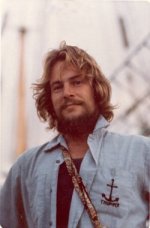
was longhaired, bearded, 20-something, practically penniless
and perfectly content as I set off on my first single-handed
voyage aboard my first liveaboard sailboat. She was no
ordinary sailboat, either.
|
|
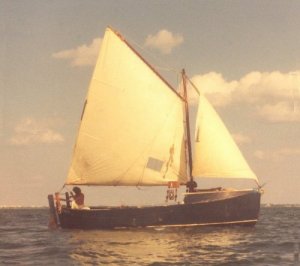
"Thumper" was a converted lifeboat, salvaged from
an old Liberty ship being scrapped in the
Chesapeake. Built in another era and for another
purpose, she sported a stout wooden mast held
aloft by cables, deadeyes and lanyards, with a
gaff-rigged main and a sadly worn working jib.
With no electrical system, her running lights were
kerosene and her one massive bilge pump, manual.
She was mostly an open boat, but with an added-on
plywood cuddy cabin forward, just big enough for a
cozy couple to sleep. Original oak plank lifeboat
benches ran around the inside of the hull and
amidships squatted a husky Gray Marine gasoline
engine, held together with Marine Tex and baling
wire, that started by means of a heavy iron
hand-crank - like an old Model T automobile.
|
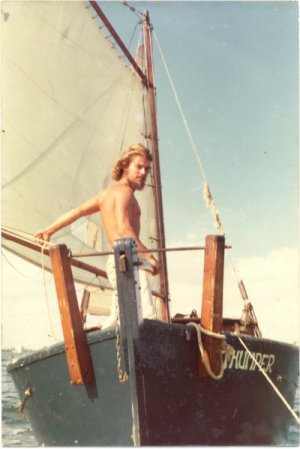
Thump'
was a salty old dog and the light of my life, though you
might not have called her graceful; a tubby 24-footer, eight
feet wide almost her entire length and double-ended only at
the last possible moment. She had been built in 1943, of
riveted steel plates. The steel was still in excellent
condition, but she had an annoying habit of popping a rivet
every once in a while so that a little fountain of seawater
would come squirting up into her bilges until I dove
overboard and plugged it from the outside. My "plug" was
most often a flathead nail with a bit of string wrapped at
the head to form a sort of gasket, the whole gooped with
underwater epoxy putty. Once the epoxy set up, it made a
serviceable, semi-permanent repair. Anyhow, the water was
warm and I was half dolphin, so it wasn't a big deal to me
at the time. I never guessed it would eventually be
Thumper's undoing - and very nearly mine, as well.
|
|
I made Key West in a series of daysails, each an
adventure in itself. A novice captain, I was
teaching myself to navigate along the way: DR, RDF,
cross-bearings and chart plotting and, with the
help of a borrowed book and a plastic sextant,
celestial navigation. Although I left my keel
print on more than one sandy shoal along the way,
I remember it as one of the happiest little
cruises of my life
Key West in the early 1970's was much less flashy,
much less developed, and much less gay than it is
today. Shrimp and lobster boats filled the main
harbor, lining the piers three and four deep.
Their scroungy, rubber-booted crews roamed the
streets and bars where pink tourists and painted
boys now tread. It was still very much a seafaring
town and I was able to anchor, unchallenged, just
off the end of Simonton Street, my big navy anchor
clinging precariously to the thin, current-swept
sand at the edge of the channel. It was there,
surveying the shoreline from Thumper's open
cockpit, that I first spotted Norma.
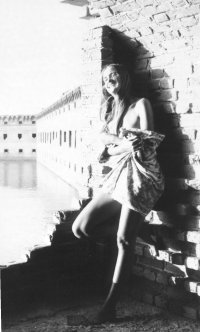
Lithe, blonde, newly tanned and fresh from
Wisconsin, Norma had somehow found her way to this
end of the world and happened to be sitting on the
seawall gazing out to sea at just that moment.
Young, bold, newly arrived and bursting with manly
good will, I did the natural thing. I dove
overboard, swam ashore, and said hello. Within the
hour, Norma visited Thumper and within
twenty-four, she moved aboard. |
So it was
that on October 13, 1974, we set sail together for the
Marquesas, a small atoll 20-odd miles to the west-northwest.
We made a credible landfall (considering I had no chart for
the waters beyond Key West) and spent a couple of days beach
combing, diving for lobsters and getting to know each other
better. Meanwhile, two other sailboats arrived in the
roadstead. We met their crews on the beach, which inevitably
led to cocktails aboard. They were on their way to the Dry
Tortugas and, after studying their charts and talking it
over, Norma and I decided to accept their invitation to tag
along when they headed west the next day.
We had
only provisioned for a long weekend, but there were sure to
be fish a-plenty and I was pretty handy with a sling.
Besides, we weren't going to stay out there very long - or
so we thought. So, on a fine, clear morning we set off in
tandem with the other two boats to make the 40-mile
crossing.
|
|
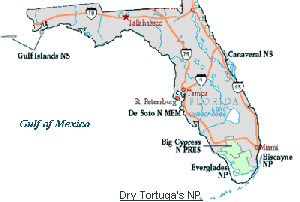
The Dry Tortugas are a cluster of low islands,
sandy shoals and coral reefs about 60 nautical
miles west of Key West, well out into the Gulf of
Mexico and separated from Cuba by the entire
breadth of the Gulf Stream waters. To get there we
had to pass Rebecca Shoal, said to be a dangerous
place in a norther. On this sunny day, however,
the breeze was light and the sea gentle, and
Rebecca Shoal slid by without a whitecap. We
arrived at our destination some time after
midnight. Our guides had been there before and led
us in through the marked channel to an anchorage
off Fort Jefferson. |
|
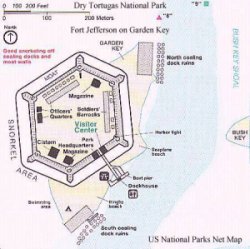
During the next few days Norma and I explored the
great fort, once a prison and now a National Park,
and the lighthouse and Coast Guard outpost on
nearby Loggerhead Key. We befriended a couple of
the young Park Rangers and met a number of other
sailors and fishermen that came and went in a
variety of vessels. In order to stretch our meager
provisions we fished and dove for conch, and we
ate well until it seemed like time to start
thinking about heading back to civilization.
But the day we planned to leave the Dry Tortugas,
the wind veered to the northeast and commenced to
blow pretty hard. A 35-footer set off for Key West
that morning only to return by noon due to rough
seas outside the shelter of the islands, and worse
at Rebecca Shoal. By the end of the day, two other
sailboats and several commercial lobster boats
came in seeking shelter from the building wind and
seas. None of us yet realized this norther would
not only get stronger, but would last for a very,
very long time, pinning us all down for the
duration. |
|
We were
stuck on this remote island with no way off and few
provisions. As the days passed and the weather deteriorated,
I moved Thumper around to a small crescent beach on the
south side of the fort, ran a long bow line to a palm tree
ashore and a stern anchor to hold us off, and settled in.
Every morning a handful of sailors met on the Park's dock
and, sharing a bucket of baitfish caught with a throw-net,
we fished until we had caught our breakfast, lunch and
dinner. It never took very long; snapper and grouper
schooled endlessly around the pilings. Then those of us with
limited stove fuel would build a driftwood fire on the beach
and cook our catch. It was all very romantic at first, but
by the end of a week or so we were getting a little tired of
fish three meals a day. Norma and I had almost nothing else
left to eat other than the last of the rice and the
occasional coconut. The wind continued to howl, from due
north now, 25- and 35-knots with higher gusts. The seas were
reported to be up to 25 feet at Rebecca Shoal. Nobody was
going anywhere, least of all my little, open lifeboat.
Thumper
didn't carry much fresh water and her assorted jugs and
containers were now nearly empty. Of course, we had been
bathing in seawater all along, but now we needed to
replenish our drinking water and that meant asking the
National Park Service for help.
The head
National Park Ranger at Fort Jefferson at that time was a
middle-aged, officious man, very much attached to his book
of rules and regulations. He was reluctant at first to share
the fort's vast reserves of water with civilians - tt wasn't
standard operating procedure - but at last even he had to
acknowledge the extraordinary circumstances. He declared
this to be an emergency situation and allowed those of us in
need to fill jugs from one of the cisterns. But he didn't
like it, not one bit.
By that
time a few more boats had straggled in from offshore,
including some big shrimp boats, their crews bearing fresh
tales of high winds and breaking seas. One morning a Coast
Guard cutter arrived towing a battered and dismasted
sailboat. Two days later, the 100-ft schooner, "Sea Star",
attempted to sail to Key West, only to come back with her
proverbial tail between her legs, unable to make headway
against the tempest. Yet all this time the sky remained
mostly clear.
October
24th, my birthday. Thumper's log reads, "A
cornucopia! I received a pack of cigarettes from Captain
Bob, a package of hot dogs from the schooner, "Sea Star",
and some C-rations from Park rangers Larry, Teage, and Jim."
|
Many boats besides us were running out of
supplies, especially food. The fort had a horde of
emergency C-rations tucked away under lock and
key, presumably for just such a time. The head
ranger had not been willing to release them so
far, but now, grudgingly, he was finally starting
to dole out a few of the variety packs. The
rations were a welcomed change after 10 days of
eating nothing but fish.
Norma was a good sport throughout the ordeal. She
helped me patch Thumper's sails and rigging, an
ongoing chore in the best of conditions, and
pitched in catching, cleaning and cooking the
fish. Together, we spent many hours exploring the
dark recesses of the great fort, swimming off the
beach, or just reading in the shade of a palm
tree. Looking back on it now, it seems our time
cast away on the Dry Tortugas wasn't so bad.
As for Thumper, she was content to wait it out.
She never popped a single rivet the whole time we
sat there in the lee of the fort.
But everyone else wanted to get going, and even I
was getting antsy. Twice we set out aboard Thumper
for Key West, and twice turned back as soon as we
encountered the full brunt of the heavy weather
outside the protection of the islands.
|
|
Halloween
inspired a full moon beach party, the shoreline coming to
life with pirates, clowns, ghosts and other unlikely
apparitions as the sailors, fishermen and even a couple of
the Park rangers celebrated in makeshift costumes. We were
all making the best of a dreary situation… all but one. The
head ranger chose that evening to inform us in quite
official tones that the National Park Service would like us
all to leave as soon as possible and that they could not
keep giving us C-rations indefinitely.
The
festivities resumed when he left, but were again interrupted
by the arrival of a Coast Guard helicopter, an eerie sight
as it swept in and hovered against the backdrop of a crimson
dusk yielding to the rising full moon. One of the crewmen on
a lobster boat, the Bonnie II, had become seriously ill and
had to be evacuated to a Key West hospital.
I was
friendly with the rest of that crew and after some
discussion, it was agreed that I would replace the lost
crewmember. So the next day I went out with them to pull
traps on the lee side of the islands. It was heavy work, but
I was rewarded with a bag-full of their canned provisions
and even some produce. That night Norma and I feasted aboard
Thumper.
The next
day it was too rough for the Bonnie II to venture out, but
the day after we caught 550-lbs. of crawfish. My share of
the catch was worth $40, a windfall to me at the time. My
earnings were "on account", to be paid when the boat
eventually returned to Key West and sold her catch.
That same
day, several of the bigger boats departed and did not
return. After a record-setting duration of 17 days, the
norther was finally blowing itself out. More boats left.
A couple
of days later, three weeks after we had arrived, Thumper
finally found the seas settled enough to head for home. We
had food (groceries and lobsters galore from my crew work
aboard the Bonnie II), water from the fort's cistern, and
15-gallons of gasoline, provided with the most gratifying
reluctance by the head ranger himself after I convinced him
we would never be able to leave without it.
We got
underway shortly after dawn, motor-sailing into a light
headwind. It looked like an easy crossing, the seas at
Rebecca Shoal having settled down completely. The trusty
Gray Marine "thump-thump-thumped" us along at nearly four
knots and Thumper's old steel plates vibrated with new life.
Maybe they vibrated with a little too much new life. Two
hours out, at 0915, the ship's log reads, "sprung a leak in
port hull just forward of engine beam." Then, at 0945,
"Taking on 25 gallons per hour. Went overboard and plugged
hole with nail and epoxy." At 1045, the log reports, "Repair
didn't hold. Trying it again with waxed string around nail
head and more (epoxy) putty." And, "Slowed leak to about 6
g/p/h." 1220: "Water rising fast again in the bilge. Two
more rivets popped, starboard amidships. Maybe three. Going
overboard to plug." And so it went. Rivets popped and I dove
overboard and plugged the holes while Norma kept an eye out
for sharks.
Norma,
bless her heart, seemed to take it all in stride. I did not.
In truth, I was a little nervous, this being the first time
in my life I had ever been out of sight of land while
skippering my own boat with no other vessels around to make
me feel secure. Thumper didn't even have a VHF radio, so
calling for help was not an option. I realized then with a
certainty that I have never forgotten that when you take a
boat to sea, you're on your own.
I handled
it. We made the Marquesas that evening, and Key West the
next day. Later that week the Bonnie II came in and paid off
her crew. By the time Thumper set sail again, east and north
now towards my homeport, Coconut Grove, I had a well-stocked
boat, fifty bucks in my pocket and a seasoned first mate by
my side. (Yes, Norma stayed aboard for the last leg of the
voyage. They don't breed wimps up there in Wisconsin!)
Thumper's hull was peppered with epoxied nail-heads, but her
spirit remained unscathed.
|
For me, this marked the beginning of a lifetime of
steadfast mates and sudden leaks, of noble boats
and forgotten schedules; the beginning of a
lifetime of cruising for better or for worse.
Since then, I've owned and skippered some very
fine yachts and logged many thousands of miles
offshore, but I never loved a boat more, or
learned my lessons better, than I did then.
A few years later, long after I'd sold Thumper, I
learned that she had popped one rivet too many and
sank. So here's to a good little ship and a
valiant voyage…and to Norma, wherever you are. May
your rivets never pop!
~ End~
|
 |
Back
to List of Tor's Tales
